What is travel photography?
Travel photography records places, people and ways of life that the photographer meets while traveling. One trip can include landscapes, street scenes, portraits, food and architecture. What holds the genre together is a sense of place: the pictures should show what a particular place is like.
Travel photography borrows from other genres, especially landscape, street, portrait and documentary photography. Many travel photographers work for magazines, guidebooks and tourism clients. Others work on long personal projects.
Main approaches
Place and landscape. Views that show the character of a region. Trey Ratcliff became known online for colorful HDR pictures of cities and landscapes.
People and culture. Portraits and scenes of daily life. Steve McCurry worked for decades in South and Central Asia, often for National Geographic. His portrait Afghan Girl (1984) is one of the best-known magazine covers.
Staged portraits of traditional peoples. Jimmy Nelson photographed communities around the world for the book Before They Pass Away (2013). The pictures are carefully arranged, and the project was criticized, for example by Survival International, for showing these peoples as unchanging. Nelson has said openly that the pictures are staged.
Tourism as a subject. Some photographers turn the camera on travelers themselves. Martin Parr traveled the world from 1987 for Small World, a critical, often funny look at mass tourism.
Nature and conservation travel. Ami Vitale and Art Wolfe travel to photograph wildlife and the people who live with it.

by Art Wolfe
History
Travel was one of the first uses of photography. Maxime Du Camp learned photography from Gustave Le Gray and traveled through Egypt and the Middle East with the writer Gustave Flaubert from 1849 to 1851. His book Égypte, Nubie, Palestine et Syrie (1852) was among the first travel books illustrated with photographs.
The British photographer Francis Frith made three trips to Egypt and the Middle East between 1856 and 1859. He carried glass plates and a tent darkroom for the wet collodion process, which had to be coated, exposed and developed within minutes. Back in England he sold his views in popular books and as prints. In 1859 he founded Francis Frith & Co. in Reigate, Surrey, one of the first firms to publish photographs on a large scale.
In Asia, Felice Beato moved to Yokohama by 1863 and photographed Japan. His albums of landscapes and portraits were often hand-colored by Japanese artists. The Scottish photographer John Thomson traveled widely in China and published Illustrations of China and Its People (1873 to 1874) in four volumes.
In the 20th century, magazines such as National Geographic brought travel pictures to millions of readers. Small 35mm cameras and color film made it easy to photograph on the move. Today most travel pictures are shared online, and the line between travel photography, tourism marketing and personal travel diaries is often thin.
Ethics
Travel photographers are often guests in places they do not know well. Ask before you photograph people when you can, and respect a no. Learn the local rules for religious sites, children and military areas. Be careful with captions: say where and when a picture was made, and do not present a staged scene as a candid one.
Editing is part of the same question. In 2016 Steve McCurry was criticized after viewers found that some of his pictures had been changed in Photoshop, with people and objects removed. Since then many publications ask travel and documentary photographers to say clearly how their pictures were edited.
Techniques
Research. Learn about the place, its customs and its light before you arrive. Many photographers note sunrise times and local events in advance.
Return to the same spot. A street or a market often looks different in the early morning, at midday and at night.
Mix wide views and details. A set of travel pictures usually needs a wide view that shows where you are, people at work or at rest, and close details such as food, hands or signs.
Light. The low light of the golden hour helps with landscapes and buildings. For people, open shade often gives softer faces than direct sun.
How to start
Travel light. A single zoom lens, or a small camera with a fixed lens, lets you react quickly and draws less attention. A phone is enough for many situations. Carry spare batteries and back up your pictures every day.
Start close to home. A weekend in a nearby town is good practice for working with strangers, changing light and limited time.
Books to start with
Steve McCurry: The Iconic Photographs (Phaidon, 2011). A selection from four decades of McCurry’s work in Asia and elsewhere.
Martin Parr, Small World (first edition 1995). Parr’s pictures of tourists at famous sights, a critical view of travel itself.
Before They Pass Away by Jimmy Nelson (teNeues, 2013). Large staged portraits of traditional communities. Read it together with the criticism mentioned above.
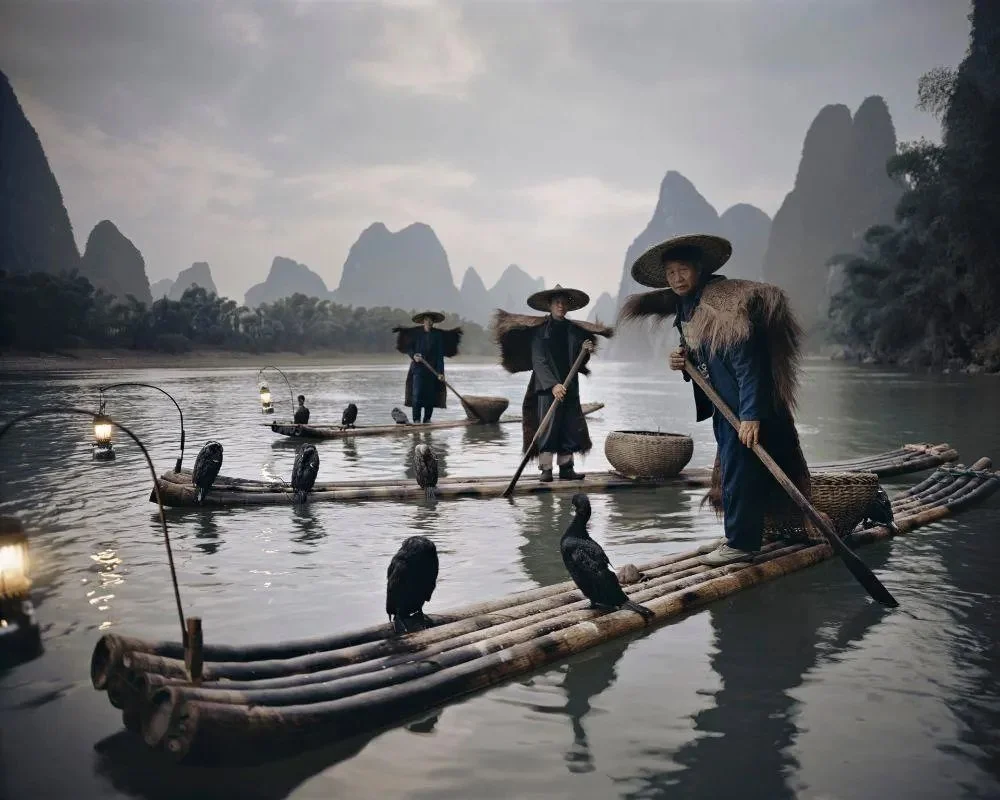
by Jimmy Nelson
Legacy
For more than 150 years, travel photographs have shaped how people imagine places they have never seen. Early views by Du Camp, Frith and Beato were sold to Europeans who wanted to see Egypt or Japan. Later, magazine pictures created images of whole countries. Because of this power, the genre is now discussed as much for what it leaves out as for what it shows.
Discover travel photographers · Travel photography in the Photopedia Dictionary
Last updated: November 2026