AT A GLANCE
- Known for
- Pictures of children at work in American mills, mines, canneries and streets for the National Child Labor Committee; immigrants at Ellis Island; the building of the Empire State Building
- Works in
- Black and white, glass plate negatives, gelatin silver prints, pictures with detailed captions
- Camera
- A modified box camera for glass plates, with magnesium flash powder; about fifty pounds of equipment on the road
- Taught
- Ethical Culture School, New York, from 1901 · Paul Strand was one of his students
- Awards
- Art Directors Club of New York medal for photography (1924) · Men at Work (1932), the only book published in his lifetime
- Start with
- Lewis Hine (D.A.P., 2012)
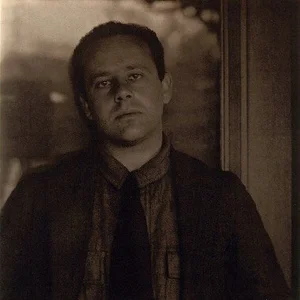
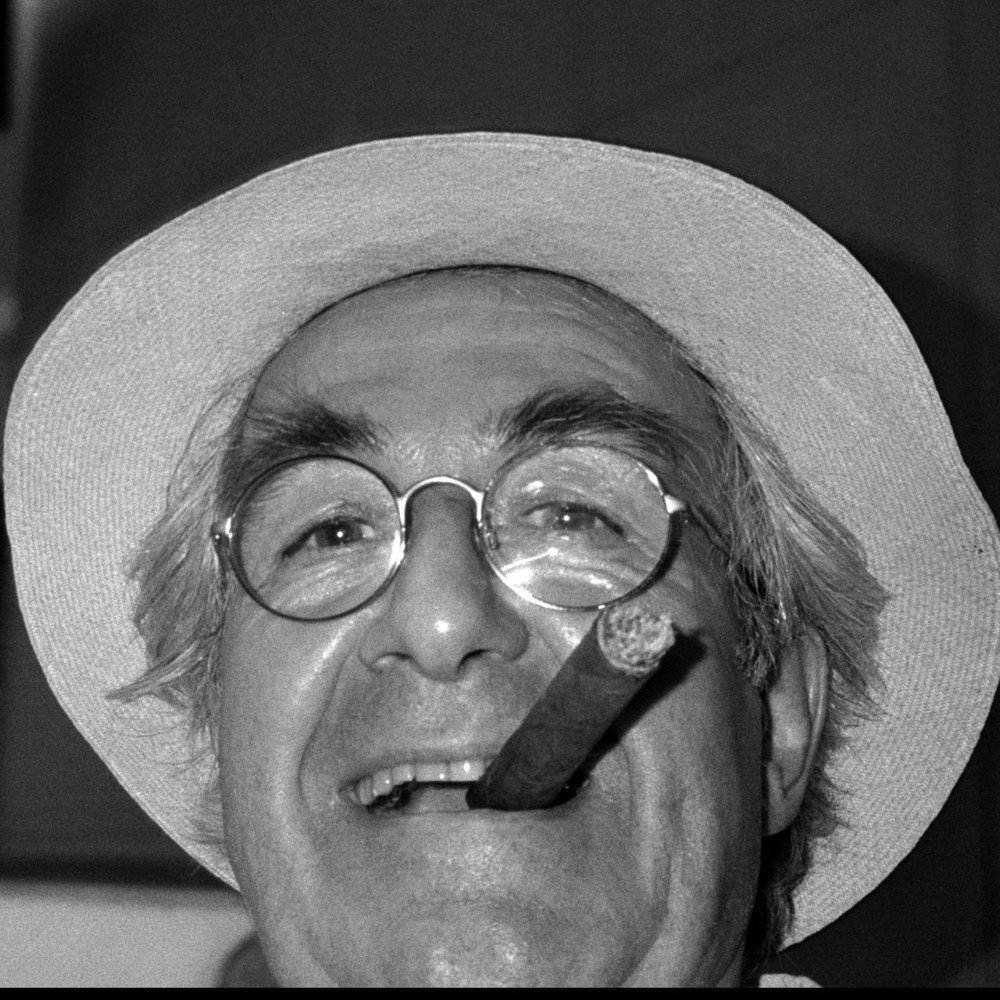
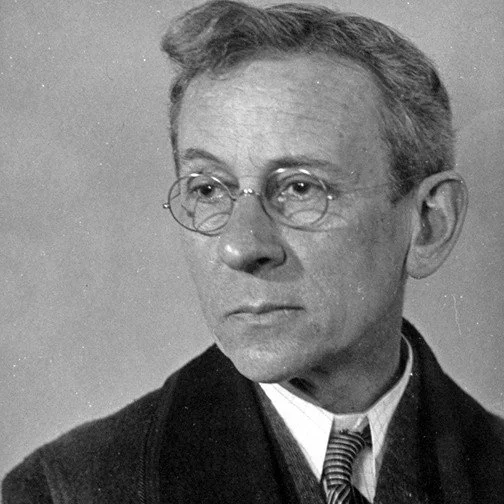
Lewis Hine (born 1874, died 1940) was an American photographer and teacher. He trained as a sociologist and used the camera to show how people lived and worked. His pictures of child workers, made for the National Child Labor Committee, helped change American law. Later he made proud portraits of workers and photographed the building of the Empire State Building.
The story
In late 1904, a young teacher from the Ethical Culture School in New York took a camera to Ellis Island. His name was Lewis Hine. He taught nature study and geography, and he was also the school photographer. It was the first of many visits. Later he explained the step simply: “I was merely changing the educational efforts from the classroom to the world.”
Hine knew hard work from his own life. He was born in Oshkosh, Wisconsin, in 1874. In 1892 his father died in an accident. The young Hine went to work in a furniture factory, thirteen hours a day, six days a week, for four dollars a week. Later he cleaned a bank. A teacher named Frank Manny encouraged him to study. Hine went to the University of Chicago, where he studied with John Dewey. In 1901 Manny became head of the Ethical Culture School and brought Hine to New York.
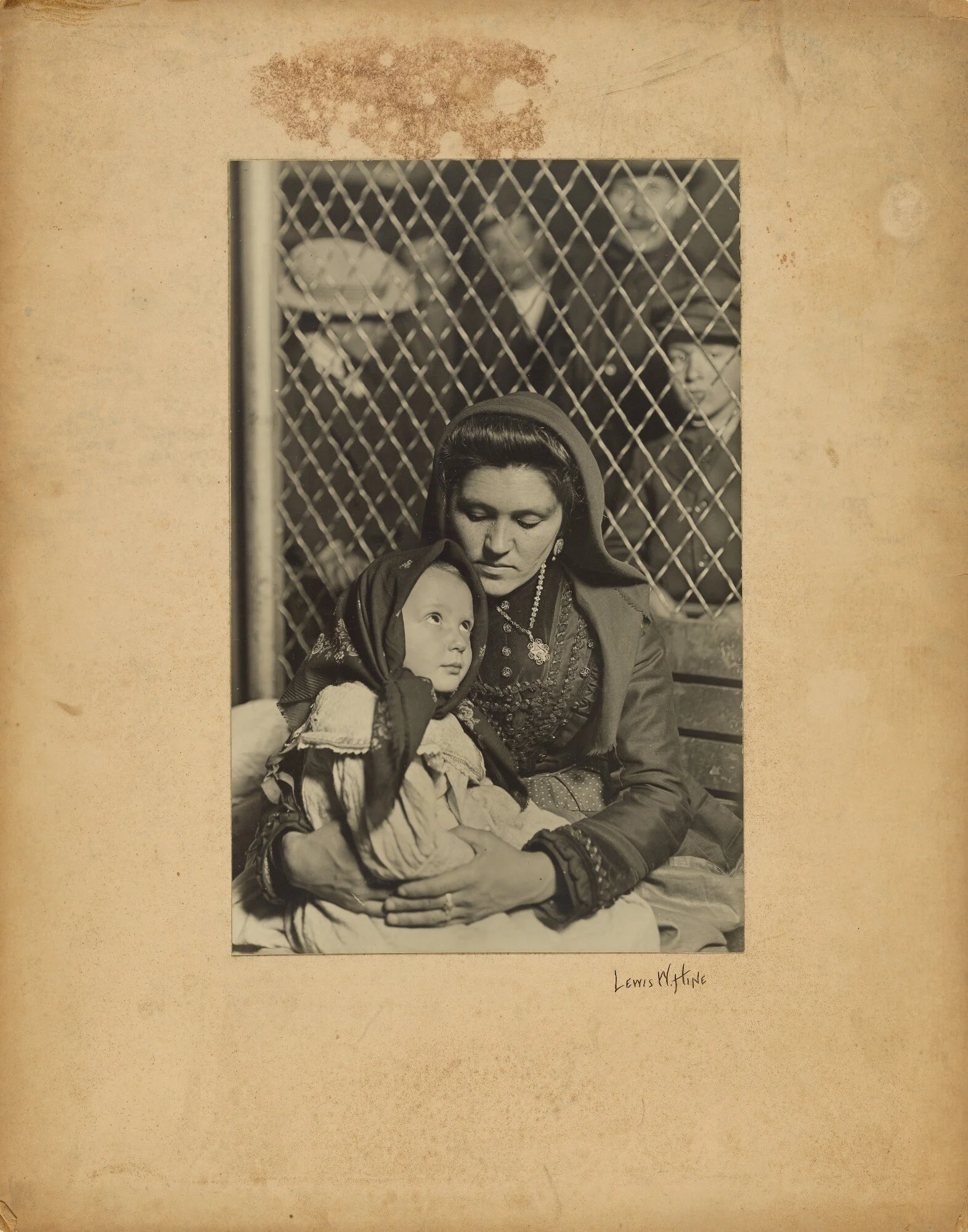
At Ellis Island Hine photographed immigrants as they arrived, often mothers with their children. [Madonna and Child, Ellis Island] comes from these years. But he wanted his pictures to do more than teach a class. In 1908 he left the school and became a staff photographer for the National Child Labor Committee. That year he printed an advertisement for himself: Lewis W. Hine, Social Photographer.
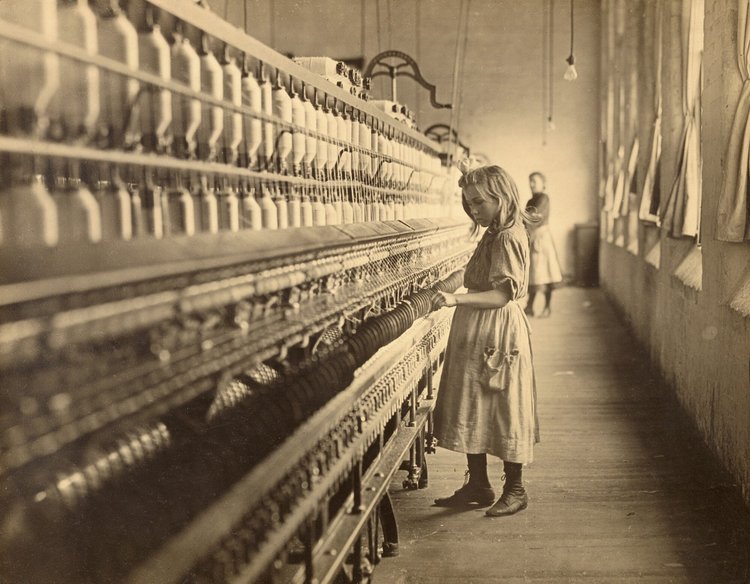
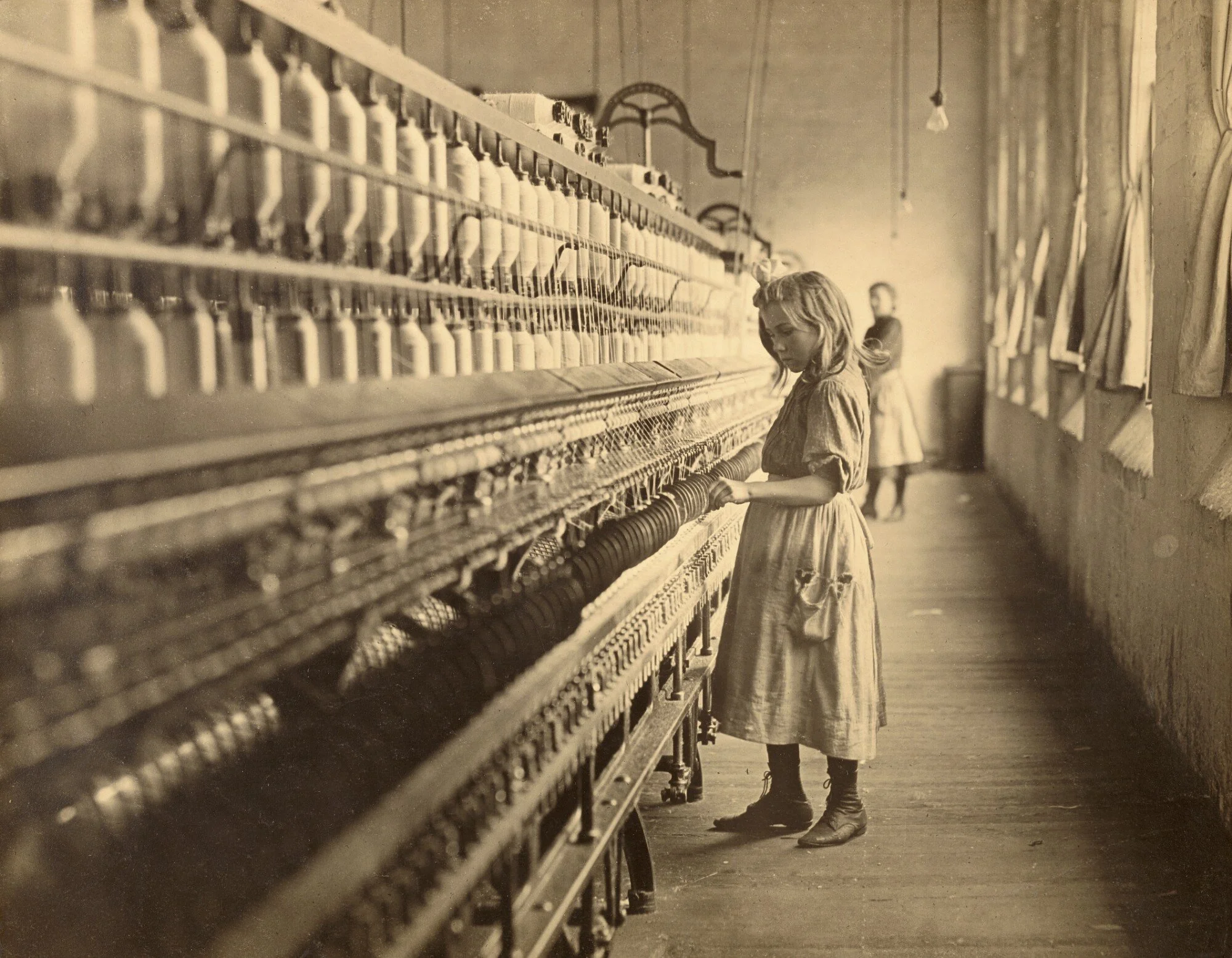
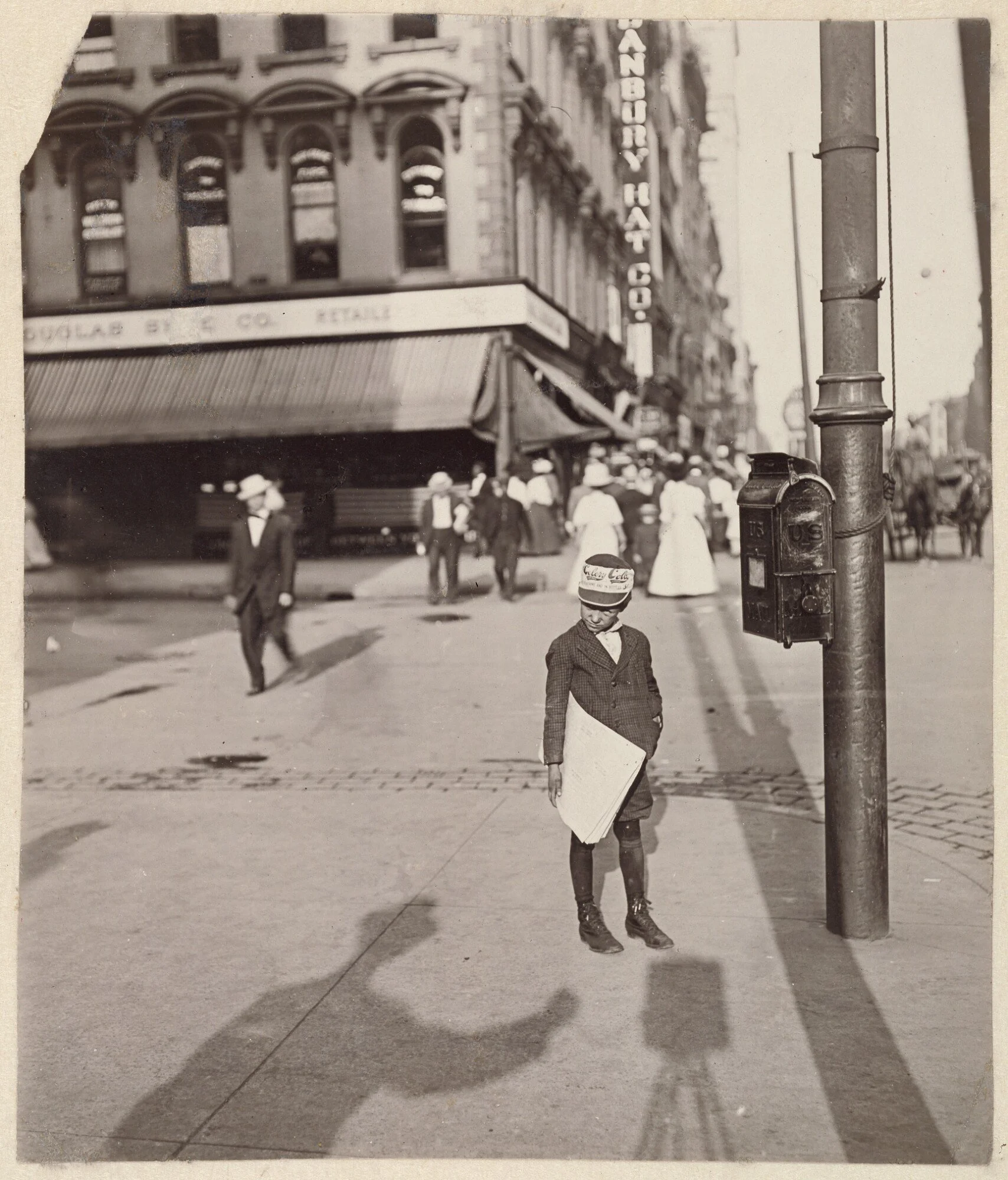
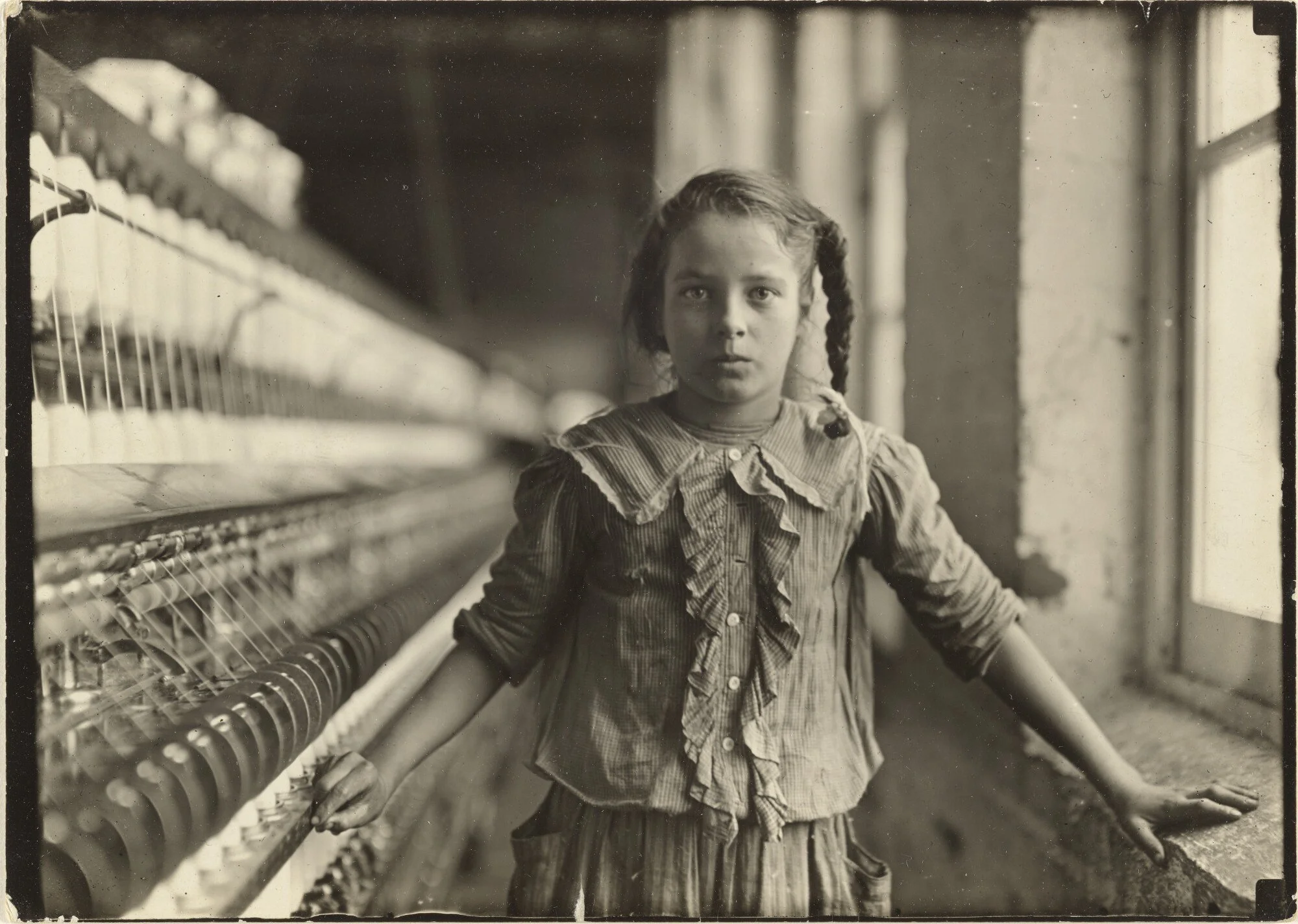
Factory bosses often tried to keep him out. So Hine called his job “detective work.” He posed as a Bible salesman, a postcard salesman or a man who photographed machines. When the door stayed closed, he waited outside and photographed the children as they came and went. He hid a notebook in his pocket. He measured children against the buttons of his vest. Sadie Pfeiffer, a small spinner in a cotton mill, was 48 inches high. In [Self-Portrait with Newsboy], from the same year, a boy holds his papers on a city street, and Hine’s own shadow and camera fall on the sidewalk in front of him.
Therefore his pictures came with facts: names, ages, heights, wages. They went into reports, exhibitions and slide lectures. In 1913 he became head of the committee’s exhibits department. He knew that people could grow tired of such images. In 1909 he told them: “Perhaps you are weary of child labor pictures. Well, so are the rest of us, but we propose to make you and the whole country so sick and tired of the whole business that when the time for action comes, child-labor pictures will be records of the past.” His photographs helped bring child labor laws in the United States.
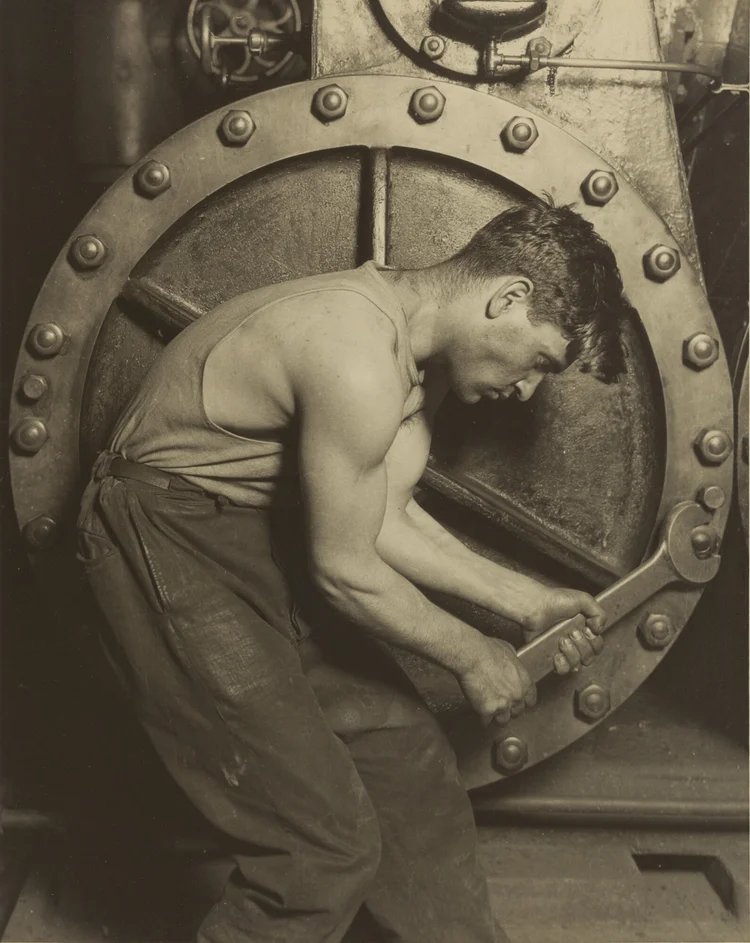
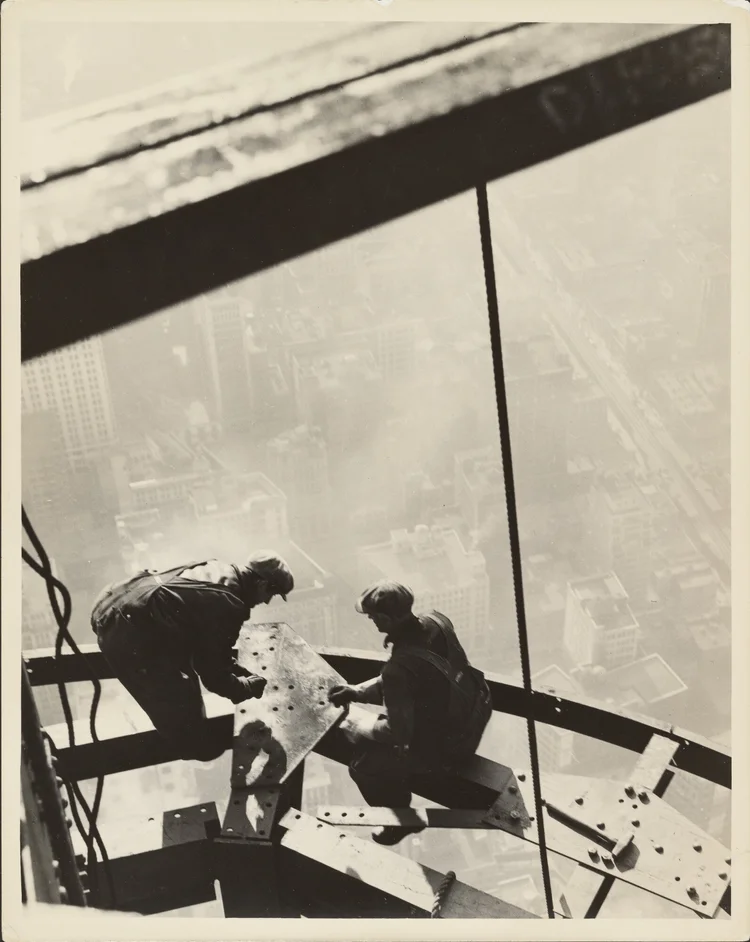
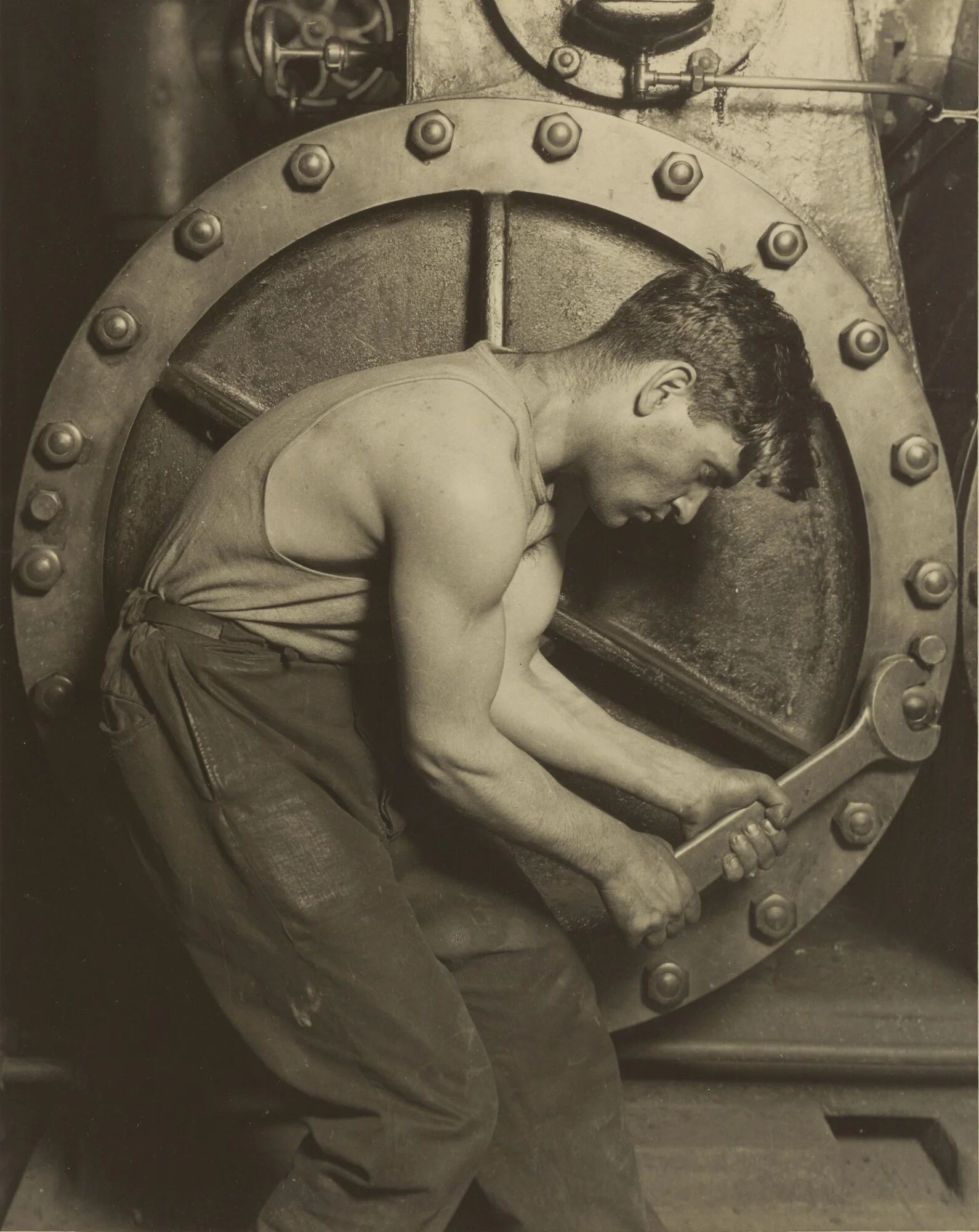
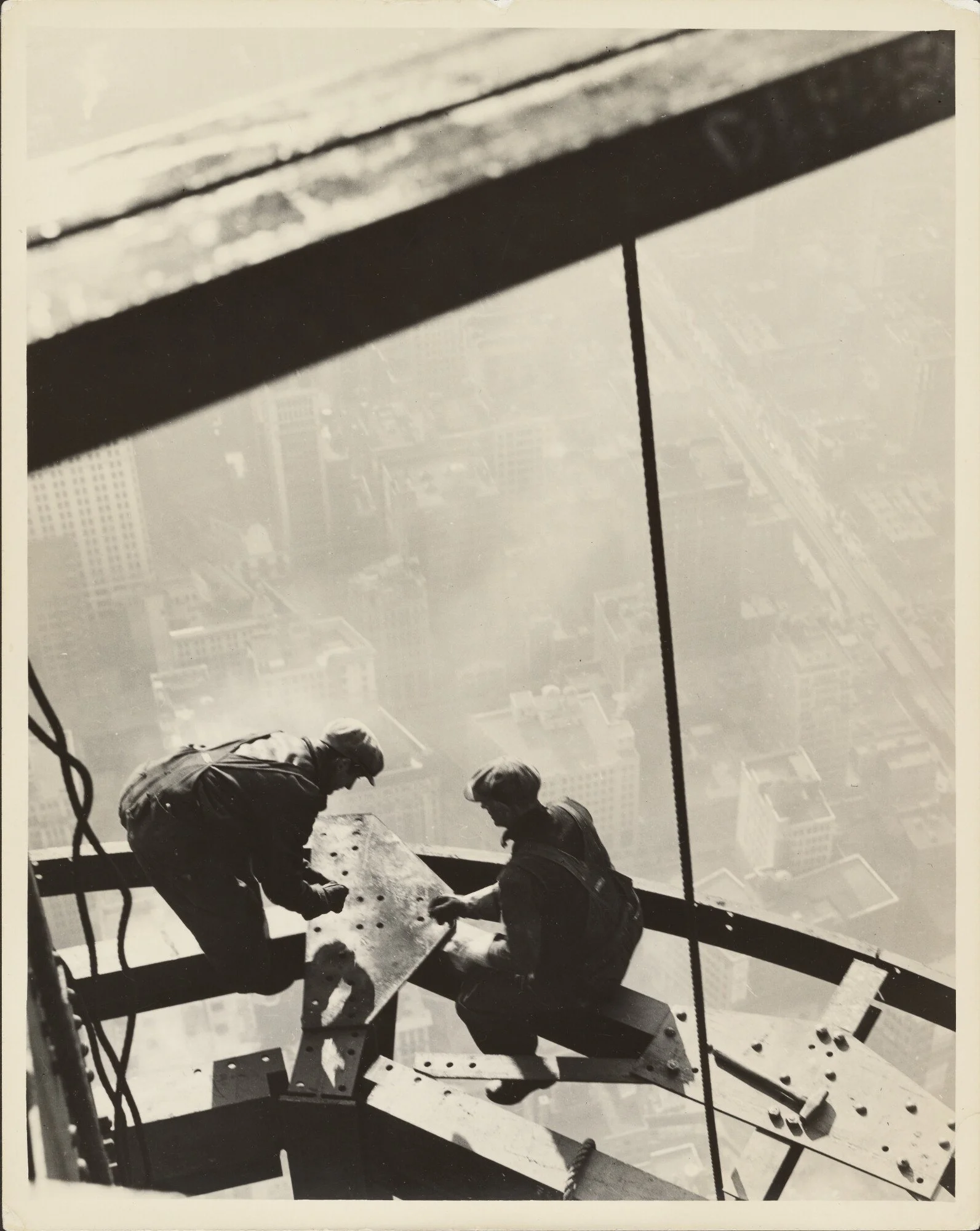
In 1918 he left the committee and photographed Red Cross relief work in France and the Balkans. Back in New York, he turned to men and women at work. Mechanic and Steam Pump (1921) shows a worker bent over a huge wrench at a giant pump. In 1930 and 1931 he followed the building of the Empire State Building. To get some views, he was swung out over the city in a basket hanging from a crane. His book Men at Work came out in 1932. But money grew short in the 1930s, and his name was almost forgotten. In 1939 Berenice Abbott and Elizabeth McCausland organised a retrospective of his work in New York. A year later he lost his house, and in November 1940 he died. He had once put his whole life’s work into a few words: “There are two things I wanted to do. I wanted to show the things that had to be corrected. I wanted to show the things that had to be appreciated.”
The work
Hine’s child labor pictures are simple and direct. The children often look straight at the camera. In Ten-Year-Old spinner in N. Carolina Cotton Mill (1908), a girl stands between long rows of spinning machines that seem to go on forever. Sadie Pfeiffer, Spinner in Cotton Mill (1908) uses soft light from tall windows, and the machine is much bigger than the girl. The Getty Museum points out how the machine dwarfs her.
Words were part of the work. Hine wrote detailed captions and coined the term “photo-story” for pictures and text used together, an early form of the photo essay. He also knew that people trust photographs too much. He warned that while photographs may not lie, liars may photograph. For him, the caption was a promise of facts.
His later work praises skill. Mechanic and Steam Pump (1921) shows a strong man and a huge machine, but the man is in charge. Hine believed a worker was not made smaller by a machine, because people had invented, built and run it. In Empire State Building, New York (1931), two workers crouch on steel beams high above the city, and the streets below look tiny. His Empire State pictures went into the book Men at Work.
- 1874Born in Oshkosh, Wisconsin, on 26 September
- 1901Moves to New York to teach at the Ethical Culture School
- 1904First visit to Ellis Island with a camera
- 1907Teaches photography; Paul Strand is one of his students
- 1908Leaves teaching to photograph for the National Child Labor Committee
- 1918Photographs Red Cross relief work in France and the Balkans
- 1930Starts photographing the construction of the Empire State Building
- 1932Publishes Men at Work
- 1940Dies in Hastings-on-Hudson, New York
Lessons
Write down the facts. Hine noted names, ages, heights and wages for his pictures. The words made the photographs hard to ignore.
Find a way in. When factories closed their doors, he changed roles or waited outside at the start and end of a shift. Patience was part of his method.
Show the good, too. He did not only show what was wrong. In his later work he showed the skill and pride of people at work.
Try this: ask one person who works near you, like a baker, a mechanic or a cleaner, if you may photograph them at work. Make one picture where their hands and their tool are clear. Then write a caption of three short lines with facts only: name, job, how long they have done it. Put the picture and the words together.
Gear
Hine worked with simple, heavy tools. He described them himself in a letter in 1938.
Box camera for 5 x 7 inch plates: he used a modified box camera with no removable back, a rectilinear lens and an old piston shutter. His published pictures were usually printed straight from 5 x 7 inch negatives.
Glass plates: he worked with glass plates, which were slow and heavy. With his other equipment he carried about fifty pounds on his trips.
Magnesium flash powder: he lit dark interiors with magnesium flash powder.
Books
Lewis Hine (D.A.P., 2012). A large survey with 230 duotone images from the collection of George Eastman House. Texts are by the curator Alison Nordström and by Elizabeth McCausland, who knew Hine. It is arranged by theme, from Ellis Island and the tenements to child labor and the New Deal years, and it includes a full facsimile of Men at Work, family photographs and a detailed chronology. The best single book for anyone who wants the whole story.
Men at Work (Dover, 1977 (first published 1932)). Hine’s own book, first published in 1932 and the only one that came out in his lifetime. This Dover edition has 69 photographs on 63 pages: coal miners, factories, railroads and the building of the Empire State Building, with 18 extra pictures of that building. Hine wrote the short introduction himself. A small, low-cost book for anyone interested in work and industry.
Lewis W. Hine. America at Work (TASCHEN, 2018). A thick, small-format book of 544 pages with around 350 photographs from all parts of his career. It is edited by Peter Walther, who also wrote the introductory essay on Hine’s life and work. The text is in English, French and German. Good for readers who want many pictures in one handy volume.
The Traveling Camera: Lewis Hine and the Fight to End Child Labor (Getty Publications, 2021). A 32-page picture book by Alexandra S. D. Hinrichs, illustrated by Michael Garland. It tells how Hine travelled the country with his camera and sometimes used disguises to get into factories. At the back are timelines, some of his original photographs and a bibliography. Written for children aged six to nine, and a good way to share his story at home or in school.
In his words
“There are two things I wanted to do. I wanted to show the things that had to be corrected. I wanted to show the things that had to be appreciated.”
“Perhaps you are weary of child labor pictures. Well, so are the rest of us, but we propose to make you and the whole country so sick and tired of the whole business that when the time for action comes, child-labor pictures will be records of the past.”
“Of course, you and I know that this unbounded faith in the integrity of the photograph is often rudely shaken, for, while photographs may not lie, liars may photograph.”
“Photography can light up darkness and expose ignorance.”
“I was merely changing the educational efforts from the classroom to the world.”