AT A GLANCE
- Known for
- The Blue Dunk (1987), The Catch (1982), more than 300 Sports Illustrated covers
- Works in
- Color, and black and white in his early years
- Camera
- Canon since the late 1970s (before that Nikon F and F2), Hasselblad for flash work
- Also
- Photographer for Atlantic Records (1968–1972), Sports Illustrated Swimsuit Issue for four decades, Lucie Award 2004
- Start with
- Athlete (Sports Illustrated, 2008)
- Links
Walter Iooss Jr. (born 1943) is an American sports photographer. He got his first Sports Illustrated assignment at 17 and has shot more than 300 covers for the magazine. He is known for planned, colorful portraits of athletes like Michael Jordan and Tiger Woods.
The story
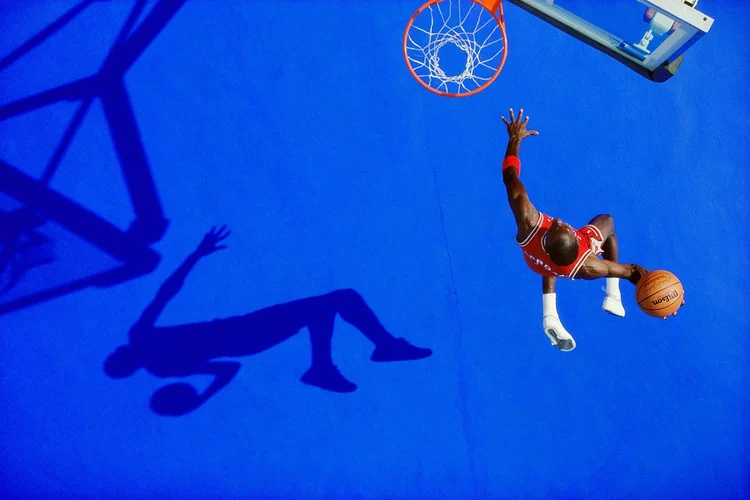
In July 1987 Walter Iooss Jr. had a parking lot painted. One half was red. The other half was blue. It was at Michael Jordan's youth camp in Lisle, Illinois, and nobody knew which uniform Jordan would wear. A basket was trucked in from St. Louis, and a cherry picker lifted the photographer high above the court. The light had to come between two and three in the afternoon, when the shadow was the right length.
Jordan arrived in red. So they used the blue side. From above, the long shadow seems to fly beside him, like a second player. “That's one of the best photographs I've ever taken,” Iooss said years later.
It all started with his father, a jazz musician and a keen amateur photographer. When he bought a camera, he also got season tickets to the New York Giants. At that game his son put his first roll of film through the camera, then developed it at home in New Jersey. “I unlocked my future somehow that day,” he remembered.
“I called up Sports Illustrated when I was 16,” he said. An assistant picture editor gave him test assignments. In 1961, at 17, came his first paid job for the magazine. By 20 he was shooting covers. In the end there were more than 300.
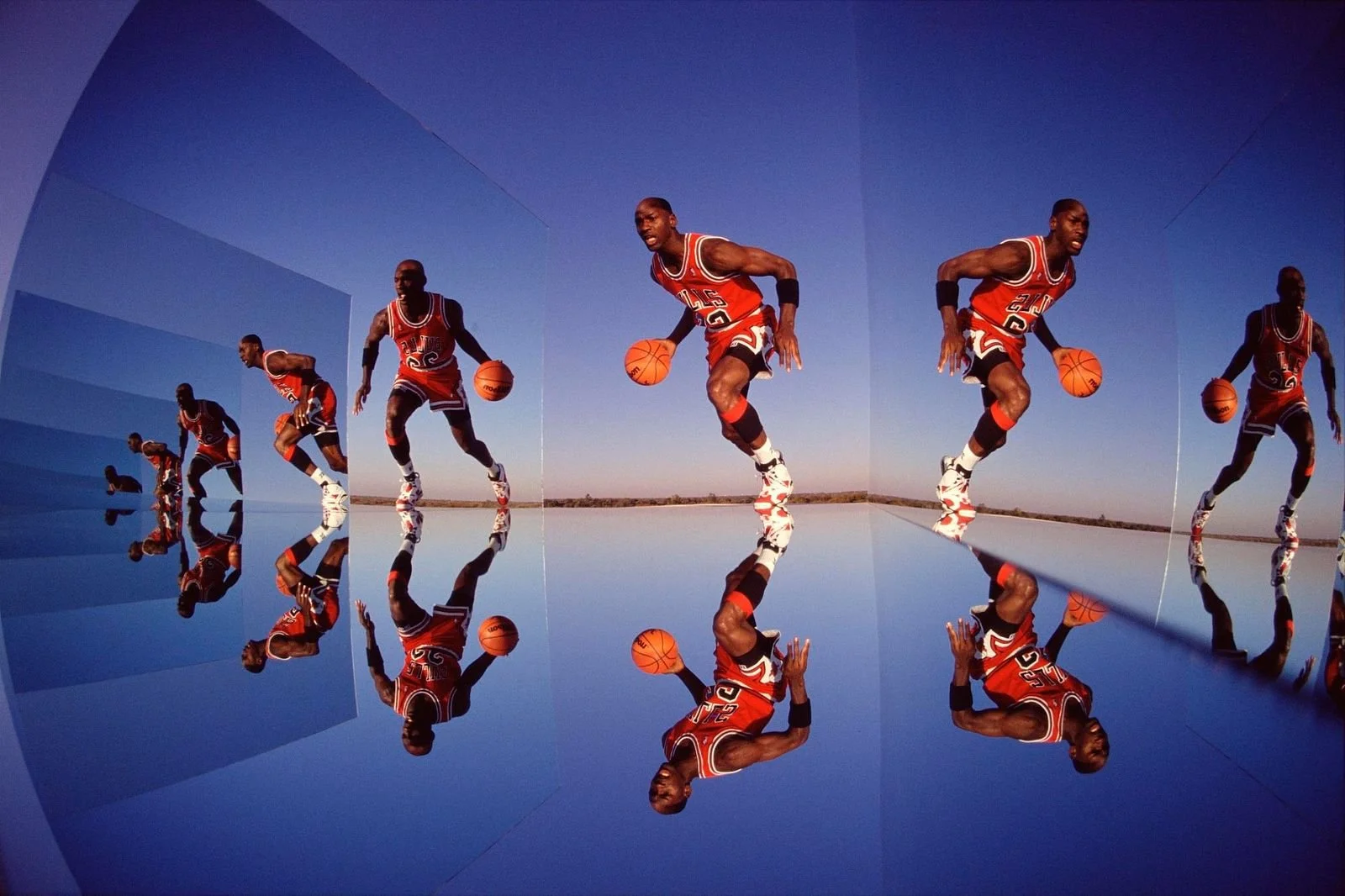
For many years the work was action, shot from the sidelines. In January 1982 he caught Dwight Clark leaping for the winning touchdown, a picture known as The Catch. But a game gives you little control. Over time he moved to portraits, where he could choose the light, the background and the moment. “I'd rather control my subjects than sit under a basket and just shoot action,” he said.
The Blue Dunk sits right between those two worlds. It looks like a split second from a game. In fact, every part of it was planned, down to the hour of the sun. The paint, the basket and the shadow were all there to make one man look larger than life.
“I like to make my subjects look heroic,” he said.
The work


- 1943Born in Temple, Texas
- 1948Moves with his family to East Orange, New Jersey
- 1961First paid assignment for Sports Illustrated, at 17
- 1968Becomes house photographer for Atlantic Records, until 1972
- 1982Photographs The Catch, Dwight Clark's winning touchdown
- 1987Makes The Blue Dunk with Michael Jordan in Lisle, Illinois
- 2004Lucie Award for lifetime achievement in sports photography
- 2018Inducted into the International Photography Hall of Fame
- 2022Retrospective The Perfect Shot opens at the Oklahoma City Museum of Art
Lessons
Plan the picture. For The Blue Dunk he painted a parking lot, brought in a basket and waited for the right hour of light. Very little was left to chance.
Watch the background. He paints, chooses or builds a clean background so the athlete stands out. A busy background can ruin a strong moment.
Let people relax. He says the best pictures often happen when the camera is down, because the subject relaxes. Give people time between frames.
Try this: photograph a friend doing a sport at a time when the sun is low. Find a plain background and place yourself so their shadow becomes part of the picture.
Gear
Canon F-1 High Speed Motor Drive: a film camera that shot 14 frames per second. He used it for The Blue Dunk. He switched to Canon in the late 1970s and became a Canon Explorer of Light.
Nikon F and F2: his cameras in the early years, after his father's Pentax with a 300mm lens.
Hasselblad: for flash work. Its leaf shutter synced with flash at 1/500 second. He used one under the basket for Jordan's slam dunk in 1988.
Mamiya RZ67: a medium-format camera for studio work. He also used a Mamiya 7 and a 20x24 Polaroid camera.
On film he used Tri-X, Kodachrome, Ektachrome and Fujichrome. Today, he says, the camera he uses is an iPhone.
Books
Athlete (Sports Illustrated, 2008). A big 256-page book, 11 x 14 inches, with more than 150 of his photographs and an introduction by Michael Jordan. It covers about 35 years of work: football, basketball, golf, boxing and baseball, along with quiet portraits like Joe Namath by a pool and Joe DiMaggio in a locker room. There are also young athletes who are not famous, such as boys playing baseball on a street corner in Havana. Iooss adds short notes on some pictures. It is the best single overview of his work.
Classic Baseball: The Photographs of Walter Iooss Jr. (Harry N. Abrams, 2003). A 207-page hardcover with text by sportswriter Dave Anderson. It follows baseball from the 1960s on, and includes many pictures from the 1960s that had never been published. Next to well-known Sports Illustrated images there are collages and portraits of ballparks he loves, like Wrigley Field, Tiger Stadium and Connie Mack Stadium. A good book for baseball fans and for anyone who likes the history of the game.
Hoops: Four Decades of the Pro Game (Harry N. Abrams, 2005). Forty years of professional basketball in his photographs, with text by the writer Mark Jacobson. It starts with players like Wilt Chamberlain in the 1960s and runs to the stars of the 2000s. Jacobson writes that the pictures show a quiet story of social change. For basketball fans and for photographers who want to see how one person covered a sport over a long time.
Rare Air: Michael on Michael (Collins, 1993). Michael Jordan's own words, edited by Mark Vancil, with color photographs by Iooss, many of them never published before. Jordan talks about the game, his family, competition and life as a celebrity. The pictures show him on the court, on the golf course and at home. It shows the close trust between photographer and athlete, built over years of work together.
In his words
“I like to make my subjects look heroic.”
“I unlocked my future somehow that day. I remember standing there by the sink and holding it up and something magical happened.”
“A lot of the times the best pictures are happening when your camera is down, because the subject relaxes.”
“I hate when I have nothing ahead of me, nothing down the line to shoot.”