AT A GLANCE
- Known for
- Early, bold color photographs of Morocco, Belgium, India, the United States and the sea's edge
- Works in
- Color since the 1970s; black and white in his early Belgian work
- Camera
- Model not documented in our sources; Kodachrome slide film for decades, digital in recent years
- Also
- Member of Magnum Photos since 1982 (full member 1986); trained in film and worked as a cameraman for Flemish television
- Start with
- Harry Gruyaert (Thames & Hudson, 2015)
- Links
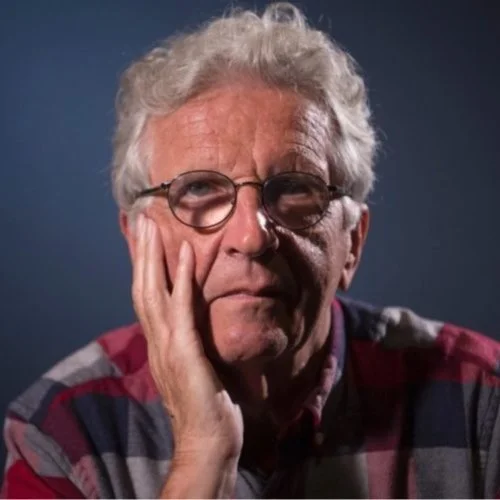
Harry Gruyaert (born 1941) is a Belgian photographer who lives in Paris. He was one of the first photographers in Europe to work entirely in color, and he has been a member of Magnum Photos since 1982. His books include Morocco, TV Shots, Edges and Homeland.
The story
At the end of the 1960s, a friend who worked as an art director for Paquet, a cruise company, asked Harry Gruyaert for photographs. The brochure was about a cruise from Marseille to Casablanca. Gruyaert said yes, and in Morocco he fell in love at once. Later he described a landscape like a painting by Brueghel, fantastic light, and people dressed in incredible colors. Europe, by comparison, was gray. From then on he had one obsession: to go back.
Photography had never been an easy choice. He was born in Antwerp in 1941, into a strict Catholic family. His father was a photographer, but he did not want his son to follow him. “There was God, the Pope and my father,” Gruyaert remembered. Still, there was no other plan. “I always knew that I wanted to do photography. There was never anything else,” he said.
In 1968 a trip to New York showed him pop art, and a new, humorous way to look at everyday things. A few years later, in London, he turned that eye on television. “I had this incredible tv set with which I could create fascinating colours, just playing with the antenna and the wires,” he said. The result was TV Shots, first shown in Paris in 1974.
Color was not welcome everywhere. In 1982 many Magnum members still believed in black-and-white photojournalism. “Some photographers argued that it would be the end of Magnum, if they accepted me,” he remembers. He joined anyway.
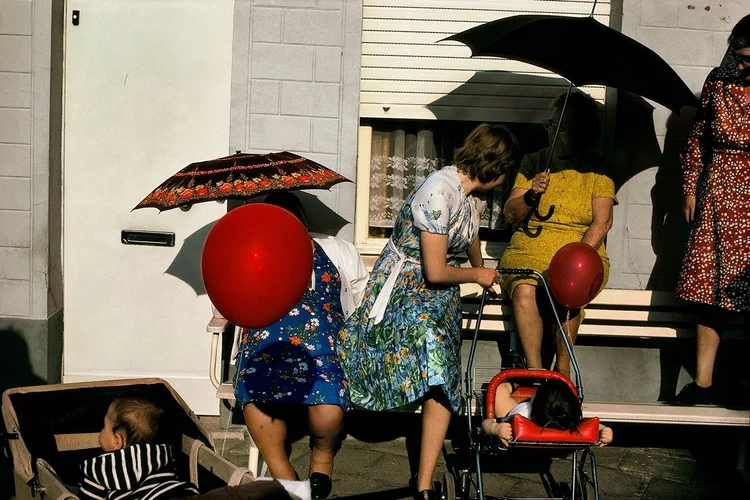
In Belgium, at first, he saw no color at all. At a parade in Brabant in 1988, he watched the people watching the parade. “The nice thing about this picture is that you don't see the faces,” he said.
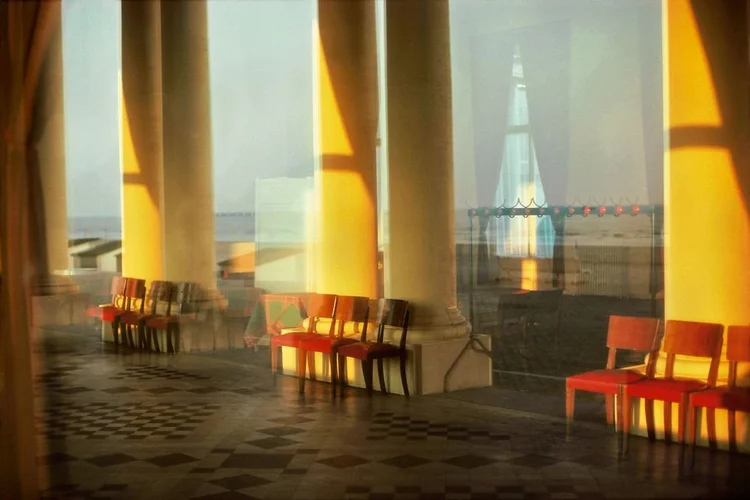
The same year, at the Thermae Palace in Ostend, sunlight turned columns yellow beside a row of red chairs. Even he cannot fully explain that picture. “I don't understand it myself, what is where. It was a strange miracle,” he said.
The cruise brochure was a job he took by chance. Decades later, his book Edges also came together by chance, when he sorted his archive and found the sea everywhere. “I had so many pictures of seasides and didn't even know. Places attract me. I don't have a concept,” he said. “Things attract me, and I attract things as well.”
The work


- 1941Born in Antwerp, Belgium
- 1959Begins studies at the School for Photo and Cinema in Brussels (until 1962)
- 1968First trip to New York; discovers pop art
- 1969First trip to Morocco
- 1972Makes TV Shots in London
- 1976Wins the Kodak Prize for his work in Morocco
- 1982Joins Magnum Photos; full member in 1986
- 2018Retrospective at FOMU, the Fotomuseum Antwerp
- 2024Publishes Homeland, a book about Belgium
Lessons
Let color lead. Gruyaert says that if you shoot in color, the color has to come first. Otherwise it is just black and white with color added.
Look at the ordinary with humor. Pop art showed him that banal things, like plastic tables or a TV screen, can carry a picture.
Follow places, not concepts. He works without a plan. Edges was born when he noticed how often the sea appeared in his archive.
Try this: spend one hour in a place you know very well. Photograph only where one strong color meets another. Do not look for a story. Look for the moment when color, light and people fall into place.
Gear
Our sources do not name the cameras Gruyaert uses, so we only list the materials he has spoken about.
Kodachrome slide film: he called himself a fan of Kodachrome and said that when Kodak stopped making it, it felt as if his eyes were being torn out.
Digital camera: in his recent work he uses digital. He says film gave him the discipline to shoot digitally, and digital gives him more control over his prints.
Books
Harry Gruyaert (Thames & Hudson, 2015). The first retrospective of his work and his first book in English. Texts are by the curator François Hébel, former director of the Rencontres d'Arles, and the sculptor Richard Nonas. It brings together pictures from TV Shots, Made in Belgium and his travels in Morocco, India, the United States and elsewhere, up to his recent digital work. This is the best single book if you want to see how his color developed over forty years.
Edges (Thames & Hudson, 2019; first published in French by Textuel, Paris, 2018). A hardcover of 144 pages with 89 color photographs and a foreword by Richard Nonas. Every image shows the edge of the sea, a lake or a river, photographed in more than a dozen countries. You see beaches in France and Ireland under dark skies, seaside fairs, ports and quiet promenades. A good book for anyone who photographs on the coast or likes calm, open landscapes with small human figures.
TV Shots (Steidl, 2007). His first serious body of work, made in London in 1972. He photographed distorted images on a television screen, including the Munich Olympics, and turned them into a strange, colorful parody of news photography. The series caused controversy when it was shown at the Delpire Gallery in Paris in 1974. The book includes an excerpt from the novel Television by Jean-Philippe Toussaint. For readers interested in pop art and in photography about media.
Homeland (Thames & Hudson, 2024; French edition by Atelier EXB). A hardcover of 256 pages with about 170 photographs of Belgium, the country he has crossed again and again for more than sixty years. Carnivals, religious processions, cafés and small brick towns appear in color, with four portfolios of his less-known black-and-white pictures printed on a different paper. The essay is by the writer Brice Matthieussent. The book for anyone who wants to see his warm, ironic view of his own country.





Harry Gruyaert has been one of my favorite color photographers for a long time. His life and work really makes you love color photography, but also helps you to decide when to think outside of the box and when to stay in.