AT A GLANCE
- Known for
- AIR, night photographs of ten cities taken from open helicopter doors at 5,000 to nearly 12,000 feet; earlier, Pulitzer-winning work for The New York Times
- Works in
- Color
- Camera
- Canon EOS-1D X and a Leaf Credo digital back, on gyro stabilizers, in a helicopter
- Also
- Director of short films and commercials, including Reverie (2008); joined Apple in 2020
- Start with
- AIR (Press Syndication Group, 2015)
- Links
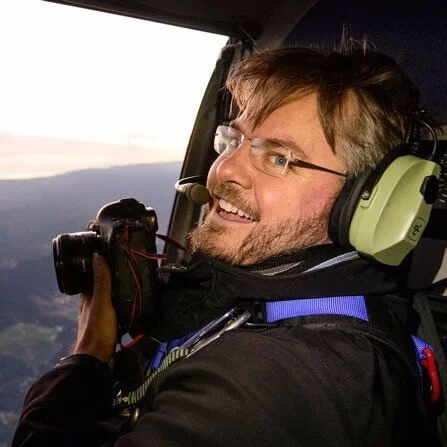
Vincent Laforet (born 1975) is a French-American photographer and director. As a staff photographer for The New York Times, he shared the 2002 Pulitzer Prize for Feature Photography. Today he is best known for AIR, his photographs of cities at night, taken from the open door of a helicopter high above the streets.
The story
On a crisp January day in 2000, Vincent Laforet climbed the Empire State Building. Then he kept going, all the way to the top of the needle. Below him, Manhattan swayed as the building moved in the wind. Two engineers were changing the antenna’s light bulb, and he pointed his lens at them. Standing on a crow’s nest about three feet wide, he began to think a harness would have been a good idea. “It was kind of terrifying,” he remembers. He made five to seven frames on film.
His career had started at 15, with internships at the Los Angeles Times and Reuters, and by 25 he was the youngest staff photographer at The New York Times. About two days after 9/11, the Times sent him to Pakistan. In 2002 he shared the Pulitzer Prize for Feature Photography with his Times colleagues for pictures of people living through the conflict in Afghanistan and Pakistan.
Later, cameras that could film pulled him in a new direction. In 2008 he directed Reverie, an early short film shot on the Canon 5D Mark II. He moved into film and commercials. “Eventually I found that the photography business was not a sustainable model for my family,” he said.
But an old picture was still in his head. As a child he often flew between France and the United States through JFK airport. From the plane window at night, New York looked like a little world. Years later, a Men’s Health assignment put him in a helicopter over the city at 7,500 feet, held in by a full-body harness, the door open. A veteran pilot the crew often flew with had refused to climb that high. Leaning out, Laforet was above the airliners landing at JFK, LaGuardia and Newark. He had guessed the streets would look like a computer chip. They did.
Online, by his estimate, the pictures were seen more than 40 million times. So one assignment became AIR, a series over ten cities, from New York and Chicago to Barcelona and Sydney. The book came out in 2015.
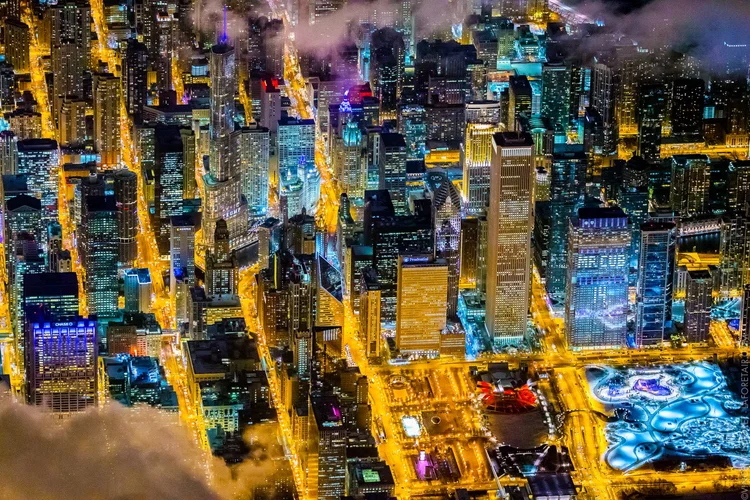
In 2000 he stood above one city with a few frames of film and no harness. Now he looks down on whole cities, glowing blue and orange, from thousands of feet. None of it was planned. “I never really meant to be an aerial photographer,” he says. “I think it happened naturally.”
The work


- 1975Born
- 1997Graduates from the Medill School of Journalism at Northwestern University
- 2000Climbs to the top of the Empire State Building’s needle to photograph engineers
- 2002Shares the Pulitzer Prize for Feature Photography with The New York Times
- 2005Named one of American Photo’s 100 Most Influential People in Photography
- 2006Becomes the first national contract photographer of The New York Times
- 2008Directs Reverie, an early short film shot on the Canon 5D Mark II
- 2015Publishes AIR, night aerials of ten cities
- 2020Joins Apple to work on photography, video and future technologies
Lessons
Do not repeat a picture. Laforet’s rule is to never take a photograph he has seen before, even one he made himself. A familiar story becomes new when the way of telling it is new.
Keep an old idea alive. He wanted to photograph New York at night from above for about 25 years. When cameras finally worked well in the dark, he was ready.
Plan the flight like a shoot. Before each flight he studies the city for lines and patterns. In the air he calls out lens changes a minute ahead, so his assistant can prepare the cameras and gyros.
Try this: go to a high window, bridge or rooftop after dark. Look for the pattern of streets, not single buildings. Notice which streets are lit blue by new LED lamps and which glow orange from old sodium lamps. Make one frame where only the lines of light tell you what the place is.
Gear
For AIR, Laforet works from helicopters with the doors removed or slid open. He and his assistant wear full-body harnesses, and every piece of gear is tied to them.
Canon EOS-1D X: his main body for the night flights, used at ISO 3200 to 6400 with fast shutter speeds to beat the helicopter’s vibration.
Leaf Credo digital back: a 50-megapixel medium-format back he also used on the first New York flight at 7,500 feet.
Canon EOS 5DS: a high-resolution body he called one of his favorite 35mm-style cameras.
Gyro stabilizers: two Kenyon gyros steady the cameras, together with fast lenses from f/1.2 to f/2.8 and tilt-shift lenses.
In 2008 he shot the short film Reverie on a Canon 5D Mark II, one of the first films made with that camera.
Books
AIR (Press Syndication Group, 2015). A large hardback of more than 220 pages, almost all in color and about 37 centimeters tall. It gathers the best pictures from his night flights over ten cities: New York, Chicago, Los Angeles, Las Vegas, Berlin, London, Miami, San Francisco, Barcelona and Sydney. They were taken from open helicopter doors at about 5,000 to nearly 12,000 feet. You see grid cities like New York and Barcelona next to cities with no grid at all, like London, and the mix of blue LED and orange sodium light in the streets. The best place to see the project as he meant it, in big prints. A book for lovers of cities, maps and night photography.
Visual Stories: Behind the Lens with Vincent Laforet (New Riders / Peachpit, 2011). His first solo book, in a square 9 x 9 inch format. In full-color spreads he explains how more than 70 of his pictures were made, with the story behind each scene and the technical details. Chapters cover his New York Times work, aerials, people, nature, surf, tilt-shift and sports, with examples from Hurricane Katrina, the Olympic Games and Pakistan. He shows how he uses light, shape, color and the link between foreground and background to tell a story in one frame. A practical book for photographers who want to learn from a working photojournalist. The print edition is out of print, but an ebook exists.
In his words
“My rule has always been to never take a photograph that I’ve seen before, let alone made before myself.”
“At the end of the day, every story’s been told 1,000 times. The way you tell it, or the way you capture it, is what makes you as a photographer unique.”