What Does It Mean to Be Close? Stephen Mccoy’s Proximity Exhibition Answers in Photographs, Not Words
Welcome to this edition of [book spotlight]. Today, we uncover the layers Stephen Mccoy’s photography and his exhibition at the Martin Parr Foundation. We'd love to read your comments below about these insights and ideas behind the artist's work.
What does it take to go beyond appearances?
Stephen Mccoy’s new exhibition Proximity asks this question with quiet humor and honesty. His work turns away from staged smiles and polished images, choosing instead the awkward, funny, and real moments of family life. The result is photography that feels closer to lived experience, showing what happens when you look past the surface.
This search for depth is not new for Mccoy.
Since the 1980s he has photographed both public places and private rooms, always testing how a picture can capture more than just appearance. Proximity brings together portraits, domestic scenes, and long-term projects, many created with large-format film cameras that demanded patience and precision. What holds them together is the belief that photography can push beyond superficiality and reveal something lasting.
Real connection asks for more than a quick glance.
About Proximity
Proximity is a solo exhibition by British photographer Stephen Mccoy at the Martin Parr Foundation, Bristol. The show brings together work from across four decades, mixing family photographs, portraits, and long-term projects. From his well-known Personal Space series of domestic life in the 1980s to portraits made in Skelmersdale and recent landscape studies, the exhibition looks at the relationship between people and place.
Mccoy’s photographs are often humorous and precise, focusing on small details that might otherwise be overlooked. By paying attention to the everyday, his work challenges the clichés of family albums and staged portraits. Proximity highlights his ongoing interest in breaking through the surface of appearances to reveal moments of intimacy, time, and connection. (martinparrfoundation.org)
Martin: How did you first start with photography?
Stephen Mccoy: Originally, I was very interested in natural history and wanted to be a zoologist. However, I flunked my science A-levels, which led me to re-evaluate what I wanted to do. I've always been interested in drawing and art, so I decided to pursue a foundation art course in Southport, near where I lived. After that, I applied to Manchester Polytechnic, initially to study illustration, but I really disliked it. Fortunately, I was able to switch midway through the course to focus on photography.
For the final two years, I concentrated on photography. It was okay. I sometimes joke that although I attended Manchester Polytechnic, I consider myself self-taught because there wasn't much formal instruction. We had critiques about once a month, and the rest of the time, we just carried on with our projects.
After my studies, I got a job as a technician in the photography department at Southport Art College. Eventually, I started teaching part-time and then went to London to earn a teaching qualification. After that, I transitioned to full-time teaching. I taught photography for around 20 years. Then, my partner Stephanie and I started a freelance business with the goal of leaving teaching altogether to make a living as freelance photographers, which we successfully did for over 20 years.
Up until recently, Stephanie has continued doing more part-time teaching, and she plans to keep that going. As for me, I've more or less retired from commercial or commissioned work and am now focusing solely on my own projects.
Why did you choose photography as your way to see the world and not any other medium?
Photography was always in the background because one of my dad's hobbies was photography. When I started to consider it seriously, he encouraged me. That led me to look critically at photography, what it can do and what it can't. I realised its potential, and I think it appealed to me because it brings together art and science.
During my teenage years, I was interested in science, so photography seemed like the ideal medium for me. I was influenced early on by the work of many American photographers. Initially, it was more formal photographers like Edward Weston and Walker Evans, and then I moved on to Lee Friedlander. That progression helped me see that photography isn't a fixed medium.
I do consider myself a documentary photographer in the broadest sense of the word. It’s about using the ability to make a record of what’s in front of the camera, what you see, but there’s so much more to it. The potential for artistic creation, asking questions, and experimenting has always interested me.
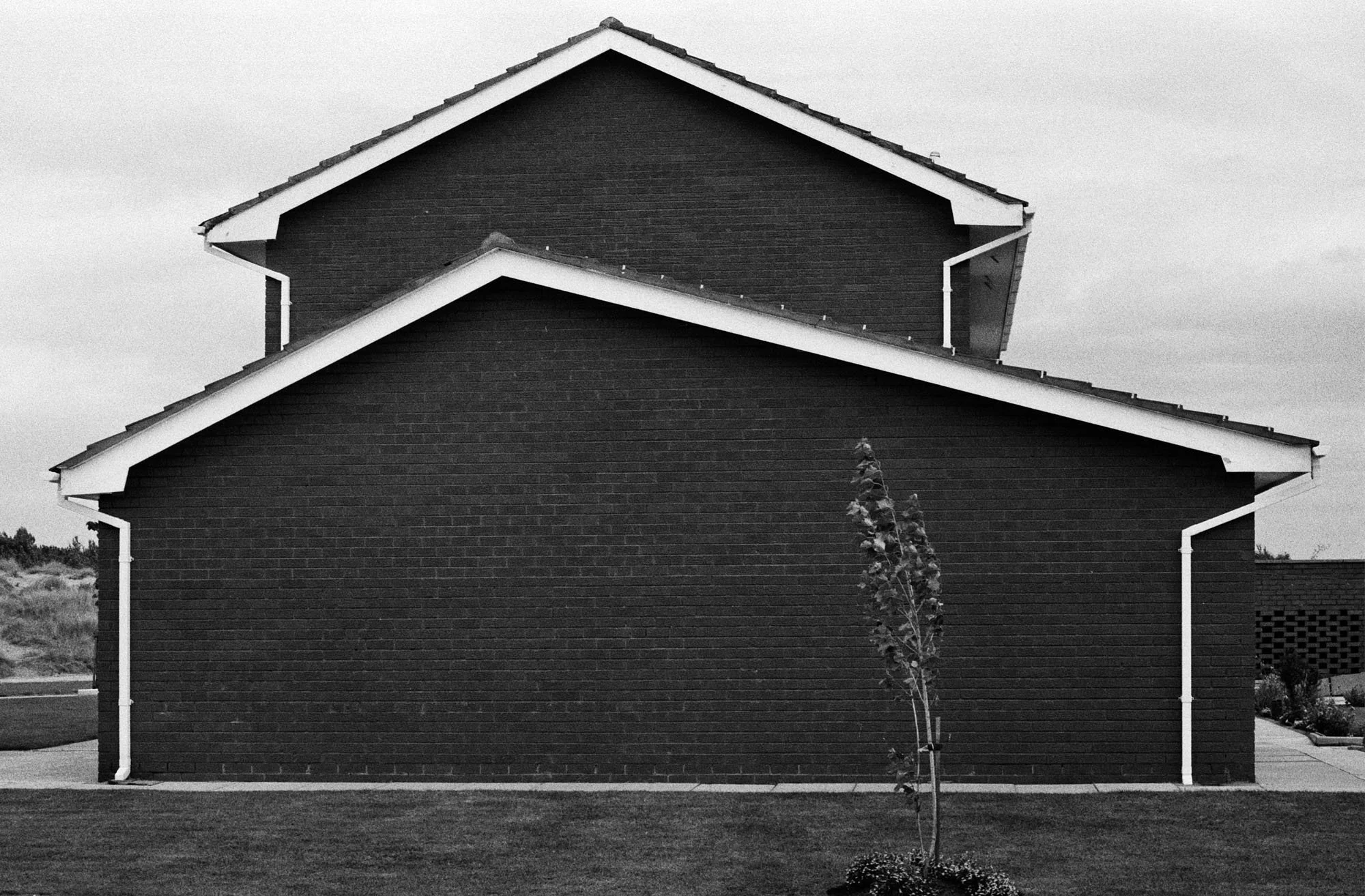
The exhibition is called Proximity. Why was it important for you to stay close to Merseyside for so many years?
Well, basically, although I've lived and worked on Merseyside for nearly 50 years, I felt I was fairly unique in many ways. This is how I approached the Open Eye Gallery in the first instance, by saying to them, "I'm unique; I don't think there's any other photographer who has worked as long as I have on Merseyside and photographed such a range of different subjects."
Originally, I went with the idea of perhaps a full retrospective exhibition, but we quickly realised I had far too much work, it wouldn't fit in the gallery. So, we had to make an editing decision about what would go in the gallery. But all the work is about my relationship to people and place. That has always been very important to me, especially with personal projects.
Obviously, with commercial work, we worked all over the UK, doing different types of assignments. But for me, that relationship added an extra layer to the work itself. It meant more to me than other types of work I did throughout the UK.
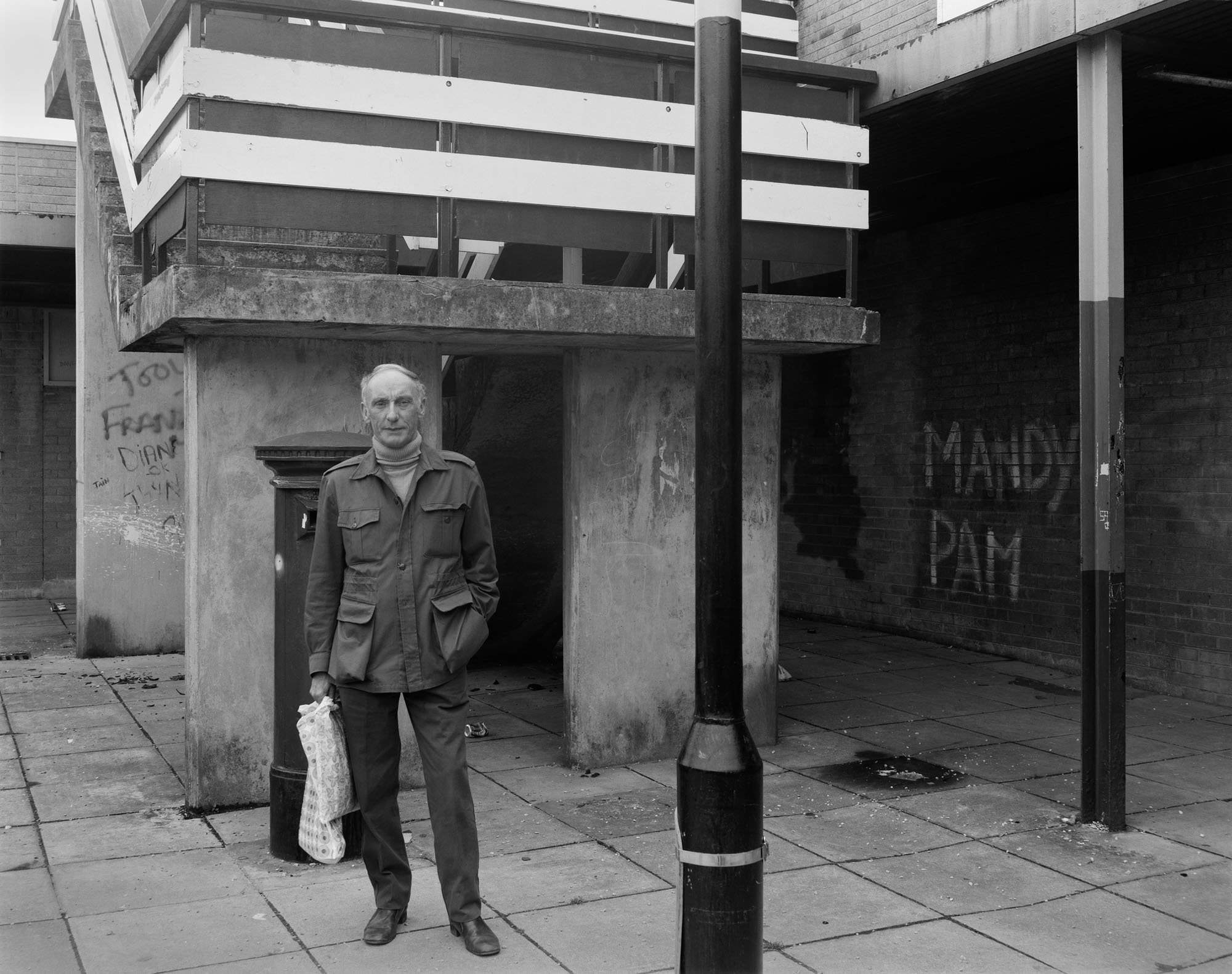
What did you learn when photographing the same place over and over again, like in the Merseyside?
That's a very good point. What has been central to my way of working is the ability to revisit places. It's not just about capturing the passage of time, photographing one area over several years shows how things change, but also about considering weather conditions and light. Being able to return to a location relatively easily allows me to refine my work.
You might go one day and realise the light isn't right, or things aren't working out as planned. Sometimes, things go wrong. But having the chance to revisit those places helps you learn from mistakes and develop the project further. Many of my projects have been photographed over several years for this very reason.
When you compare this photography with the places you have travelled to, do you think it made you go deeper when staying in the same place, like photographing your own area repeatedly?
Yes, I think that's true, definitely. A lot of photography can be regarded as superficial, often because photographers visit a place briefly, maybe a day here, a day there. For me, that type of photography always has a certain level of superficiality. I believe you need to know a place very intimately to produce really good work.
By revisiting places, looking at things differently, and especially with my housing estate work, I was able to develop ideas through various ways of working. I started photographing with 35mm, using very high contrast and a red filter, a very mannered way of working. Then I moved on to a more deadpan, bland style with colour medium format, 5x4 colour, and 5x4 black and white. I was able to explore these different methods while photographing within the same area.
This process added layers of complexity and new ways of analysing my work with the same subject. That kind of intimacy with the subject allowed me to push things further and demonstrate progression. One of my goals in the exhibition at the Open Eye Gallery was to showcase my process, my way of working, and how my approach has evolved.
Can you share a moment when you realised that your home place was enough? A moment when you realised, "This is it, I'm getting deeper into something more meaningful than I would if I were just travelling or being superficial," as you mentioned.
Yes, certainly. For the "River to River" work, which focuses on photographing the coastline near where I lived, it really depended on my ability to visit frequently. If the light conditions were right or something changed, I could quickly jump in the car, drive down, and walk along the beach, spending quality time there.
Some days were unsuccessful, but that’s part of the process. You have good days and bad days. Working on something over a long period can also be influenced by people you meet. You might be working on a project that isn’t going well, and then you see a body of work by someone else or meet another photographer. Their approach can spark new ideas for how you photograph a particular subject.
For instance, the first set of housing estates I photographed featured very high contrast. I was trying to convey the surreal nature of these estates. Then I attended a week-long workshop with Lewis Baltz, a new topographic photographer. That experience made me realise you don’t have to photograph in an overly stylised way. You can focus on specific light conditions, choosing to photograph under grey skies with bland light, to achieve a deadpan, neutral, almost emotionless style.
That workshop influenced that particular set of work. Later, with "River to River," I moved away from that deadpan black-and-white approach. I started photographing in colour, paying close attention to light and weather conditions. It’s like I was reacting to my own previous work while also being influenced by other photographers on one particular subject.
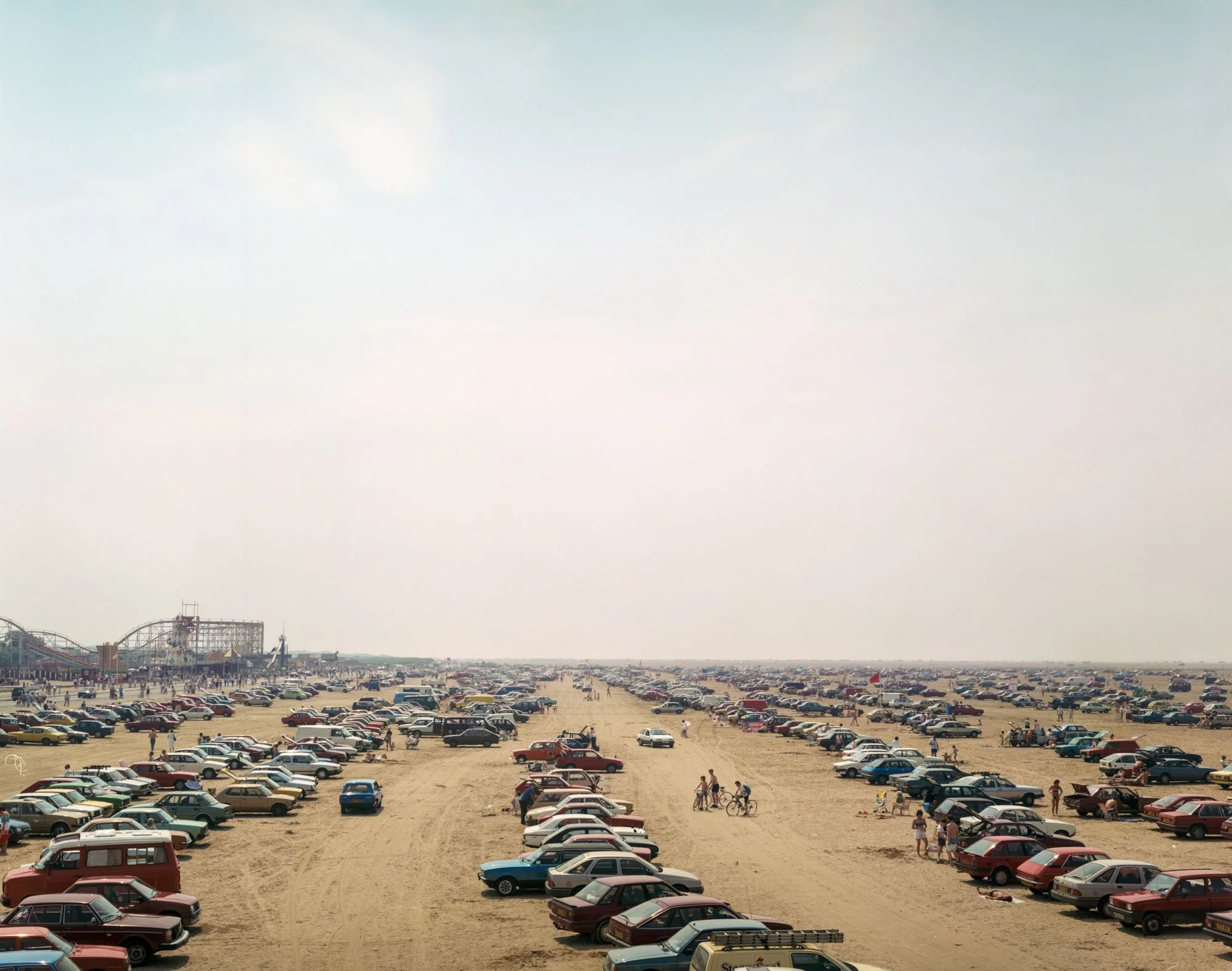
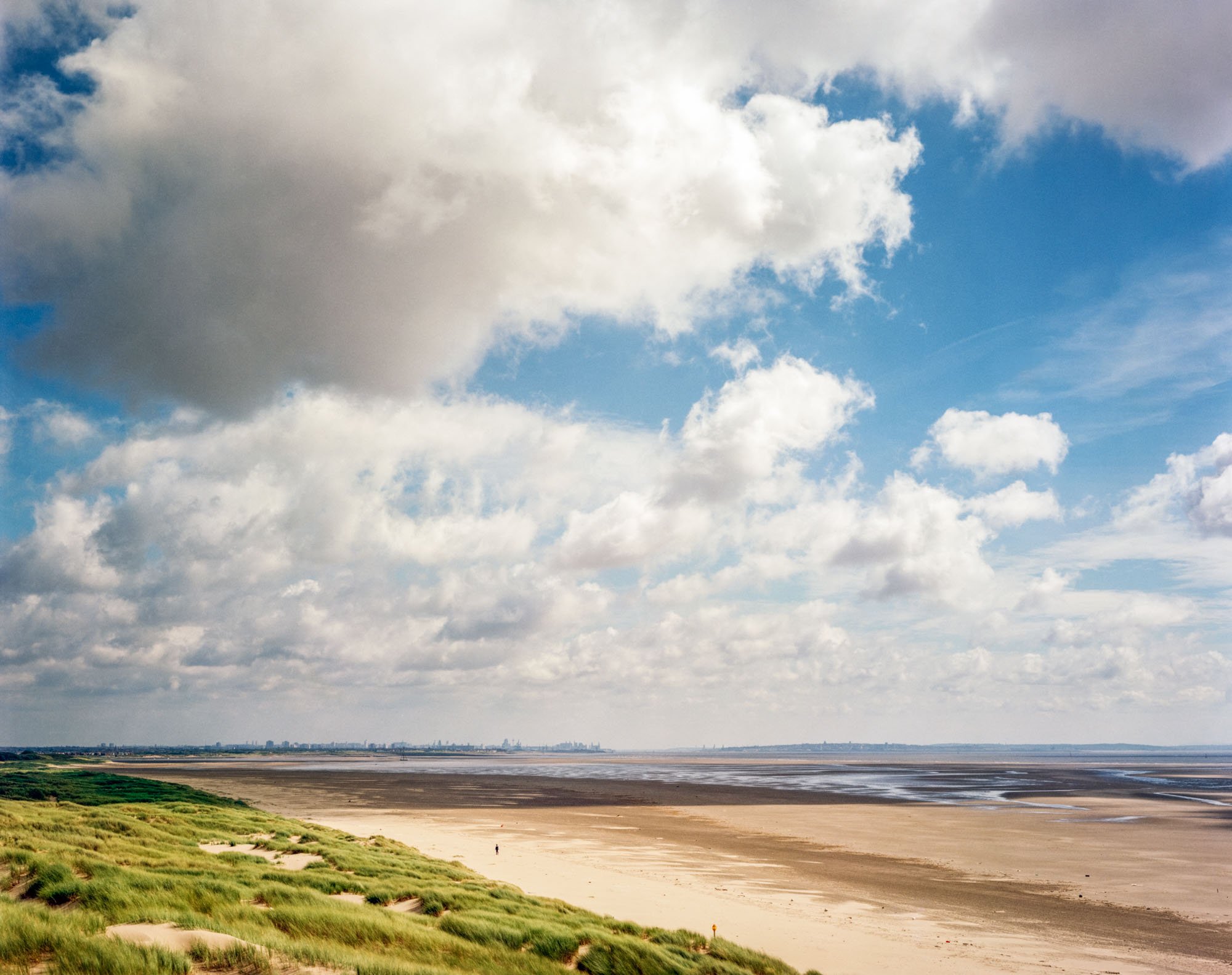
Was there a moment when you realised you were breaking through superficiality in your photography? Like, looking back at some older photos and thinking they were just skimming the surface, while others felt much deeper. Can you see that shift in your own work?
Yes, I hope so, and I hope others appreciate that too. One of the challenges with photography, for me, is that a single photograph often lacks a sense of time. How long did it really take the photographer to capture that moment? But when you have a series of photos, a project developed over many years, that sense of time becomes more apparent.
It's the idea of having photographs that reinforce one another within a set or project. The passing of time, or the time the photographer invested, becomes more visible. I think that's quite important. Spending time on something, revisiting places repeatedly, conveys the effort and attention the photographer has dedicated. It's not just about taking a quick snapshot and moving on to the next subject.
Some of your projects are very personal, like "Every House My Mother Lived In." Others seem more like social history, such as "Skelmersdale." How do you move between personal and public stories?
I don't really have a problem with that. I think "Skelmersdale" in particular was a bit different because it was a commission by Merseyside Arts. They asked me to spend a day a week at the local art college, working with a couple of students as a sort of photographer in residence. The brief was very open. I went out with one or two students, taking a mixture of portraits and landscapes of the area.
Skelmersdale was, and still is to some extent, a very troubled area. I won’t go into the whole history of it, but it has suffered a lot from deprivation, poor-quality housing, and unemployment. I must admit, it taught me a lesson: I don’t really want to photograph strangers anymore.
I was going there, stopping people in the streets, asking them to stand in a place, and using a 5x4 camera to make a portrait. I would always ask for permission and explain what I was doing, but I felt very much like an interloper. I was visiting this place, photographing people, spending five minutes with them at most, then leaving and returning to a more comfortable lifestyle. I felt very awkward doing that.
The debate about exploitation is very complex with many layers. Photographers deal with it in their own way. But I felt as though I didn’t want to photograph strangers anymore. I had always done portraits, but they were of family members, friends, and work colleagues, people I had a relationship with. They weren’t strangers; they were people I could see many times, talk with, and connect to beyond the photograph.
This experience moved me away from photographing strangers or doing street photography. Prior to that, I was working on several projects simultaneously. One was the "Personal Space" project, which involved photographs in my own home, friends' homes, capturing events and funny happenings within the safe environment of a home.
I think working on a range of projects simultaneously keeps you fresh. You’re jumping between 35mm and 5x4 formats, dealing with different problems and outcomes. For me, that approach has worked well.

When you photograph something close to you, like your family, how do you ensure that other people can also connect to it?
That's a difficult question. Some people will connect, and some won't. If it's displayed in a gallery, people can see it there. If it's published online, people will come across it. They might relate to it, or they might not. Most of the feedback I've received has been very positive, indicating that people can relate to what I’m photographing.
I sometimes think that even though I'm capturing something very personal, there’s an element of universality in it. Many people can connect with the experiences depicted. Often, this connection comes from viewers who share a similar cultural background with me, which helps them relate to the work. Generally, people appreciate what I’m doing.
It really depends on the audience. For instance, if my work is exhibited in a photography gallery, other photographers might appreciate it differently than my sister would. She might walk into the gallery and see a photograph of herself, experiencing it on a more personal level. You can't predict exactly how people will react or appreciate your work. All you can do is be honest and make sure your work is visible, whether it’s on a gallery wall or through any other means.
So, is there an overlap in your approach, or is your style different for personal projects and public stories?
The main division isn't necessarily between public stories and personal projects, but rather between personal projects and commissioned work. There's a clear difference in the relationship with people. We've done a lot of portraits, academics, artists, and the like, and in those cases, there's a specific brief. You go, take a photograph, and if they're happy with it, that's great; you get paid. It's a different dynamic compared to photographing a stranger on the street or members of the family.
I've never had a bad reaction from friends or family members I've photographed. If someone was genuinely opposed to me showing their photo publicly, in a gallery or online, I suppose I wouldn’t display it. But that’s never happened. I’ve always managed to negotiate, discuss, and talk it through. For example, in an exhibition at the Open Eye Gallery, there was a photograph of a friend from university. He had never seen it before, so I invited him to the exhibition, and he was really pleased. It’s not about adulation; it's more about them feeling recognised and portrayed well. The image doesn’t show them in an unflattering or disrespectful way. It's respectful, and that’s important.
In my personal projects, humour plays a big role. A lot of what I do includes elements of humour, and I enjoy that. I think photography often tries to be very serious, meaningful, and profound, which is valuable, but there’s also space for humour. Humour can be significant too.
You often photograph very ordinary things like houses, rivers, even dust from a carpet. What makes you focus on these everyday objects?
I don't really know. I think what happened was that I became less interested in photographing strangers and people per se. I've always been very interested in the effects people have on an environment, whether accidental or deliberate, the way they personalise a space, for instance. Sometimes things just occur to you.
Take the archaeology of carpets, for example. I was vacuuming the carpet one day with a Dyson vacuum cleaner, and I found it fascinating how the layers were building up in the cylinder. If I’d been drilling holes in the wall, there’d be a layer of red brick dust. After Christmas, I’d be hoovering up old Christmas tree pine needles, leaving layers of pine needles. After a birthday party, there’d be traces of that too. It became an obvious record of family activity.
Because they were photographed in a certain way, these images became abstract, which I think attracted people to look at them. Imagination, creativity, and questioning are all central to a lot of what I do.
This show covers 45 years of your work. Do you see a change in how you take photos from then to now?
Yes and no, I suppose. I think the most recent set of work is of the Rimrose Valley, which are landscape photographs that I've been focusing on quite a lot. When I look at the final images, you could say they are similar to the River to River landscapes or have some elements in common. But obviously, the biggest change, and this is part and parcel of photography, is the advancement of technology, which changes the way of working. I'm working exclusively digitally now. So, although I might be photographing very similar subjects, the way I work has changed a lot. I'm using the iPhone much more than I ever used to, not just for lifestyle photographs but in a very deliberate way for serious photography.
That changes things, but in some cases, you could say I haven't really progressed at all. Looking back at some of the early landscape photographs, they are quite similar to a lot of the Rimrose Valley photographs in terms of light, colour, and exploring notions of the romantic landscape. I’m still investigating ways images can be made. I consider myself, to a certain extent, a formalist. I like to play around with the form of photography and am very much concerned with composition and structure. The way photographs are displayed also interests me.
Sometimes I even think maybe there isn't any linear time at all, perhaps time is just circular. You go around in a circle and end up back where you started. I was driving to Southport to see my son the other day and passed a housing estate that I photographed 40, 45 years ago. I thought about getting my camera out and taking a few more photographs. I resisted the urge, but the thought was definitely there.
Some of your old photos feel more important today than when you took them, do you look at them differently now?
Yes, I think so. When I was taking the photographs, I was obviously documenting changes in many cases. I'm glad they exist as historical documents. At the same time, I always wanted them to be seen as art, not just straightforward factual photographs. There are elements in them that people can appreciate from an artistic point of view.
A few people have described the photographs as nostalgic, but I don’t use that term. It implies looking back at things from 45 years ago as if they were better then than they are now, but they weren’t. Things are far better now than they were back then. Nostalgia doesn’t really influence how I appreciate my early work.
Another point is related to technique and how working methods have changed. Virtually all the work in the exhibition that was shot on film has been scanned. Scanning has reinvigorated some of the photographs that I couldn’t use initially because of technical issues, like bad scratches in the sky. Being able to retouch and repair them has allowed me to reanalyze early work that I had originally dismissed purely on technical grounds.
Editing has also been challenging. Not only did we have to narrow down the projects included in the exhibition, but we also had to select a limited number of photographs within each project. It’s incredibly difficult to go through bodies of work and reduce them to 20 or 30 images. I relied heavily on Stephanie to go through the material, double-check things, and help make those final decisions. You tend to think that every photograph you take is worthy, otherwise you wouldn’t have taken it in the first place.
When talking about projects, do you usually have this realization that the project is done and you don't need to take any more pictures? Or do you feel you haven’t broken through the superficiality yet and need to add another layer? How do you think about this, the progression of the project?
I think once I feel as though I'm getting bored or repeating myself, I realize that maybe the project is done. But if I still feel inspired to actually make the effort to go out with the camera and photograph a particular subject, then it's not done. It sort of happens automatically. You just get bored with what you're doing, and then it's time to move on to something else or look at something in a different way.
The Rimrose Valley work, for example, originally started because the actual valley was under threat from the building of a dual carriageway. I began documenting it just in case it eventually became a busy roadway. However, the threat of that dual carriageway ceased after the last election, so that project has come to an automatic end.
When you say you stop working on a project because you get bored, you have so many images, right? But when you publish a book or prepare an exhibition, there are only so many you can show. So there's quite a narrow selection from the amount you’ve taken. Has it ever happened that you had a project, continued it for so long that it completely changed direction, and the final product was different from what you started with?
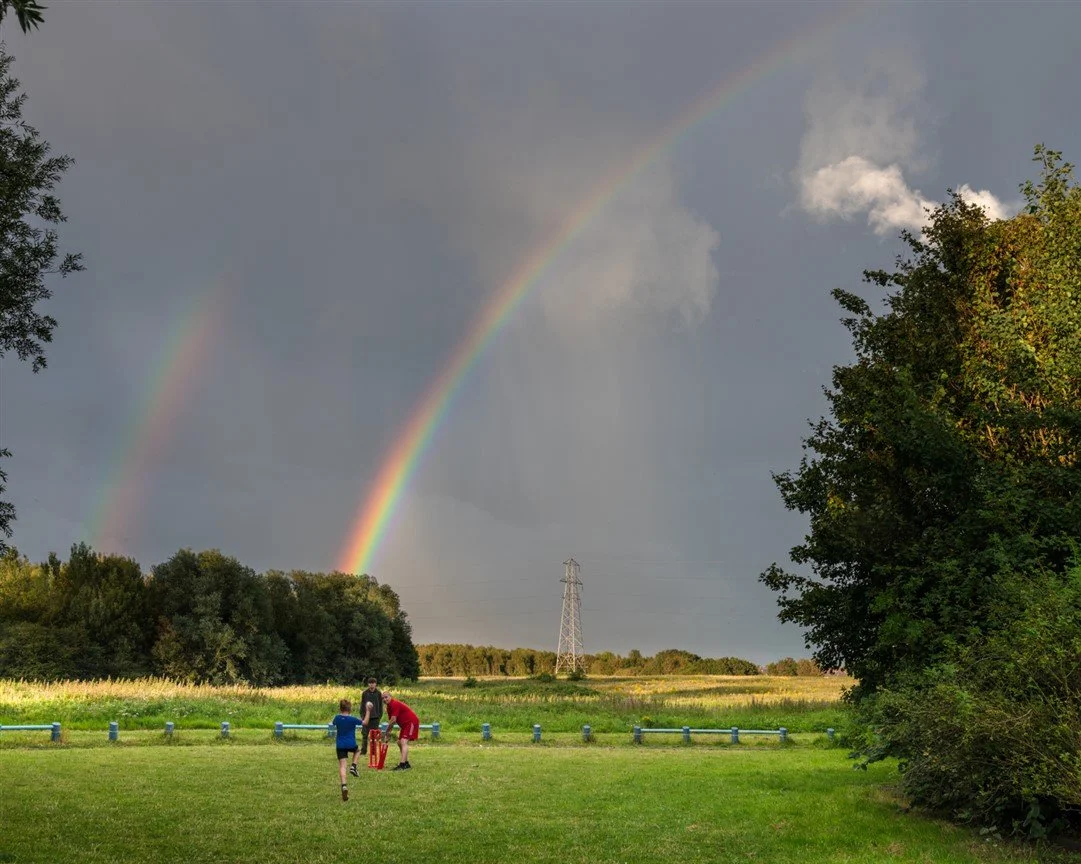
I can’t think of any examples, to be honest. I mean, the Rimrose Valley, for instance, which is the most contemporary work in the exhibition, kind of changed. When you start a project, like a lot of photographers, you’ll be photographing a lot of things, looking at different subjects, close-ups of different elements. I eventually narrowed it down. For the Rimrose Valley photographs, I knew I didn’t want to do portraits of anyone using the valley, but I wanted a kind of human presence.
I started making photographs where there was somebody very small in the frame. I came across the idea of what’s called staffage. English landscape painters like Constable, for instance, used to paint landscapes with very small figures to give a sense of scale. That interested me, the idea that they weren’t just people but symbols of people. That’s why I started taking photographs with very small figures in the frame in Rimrose Valley.
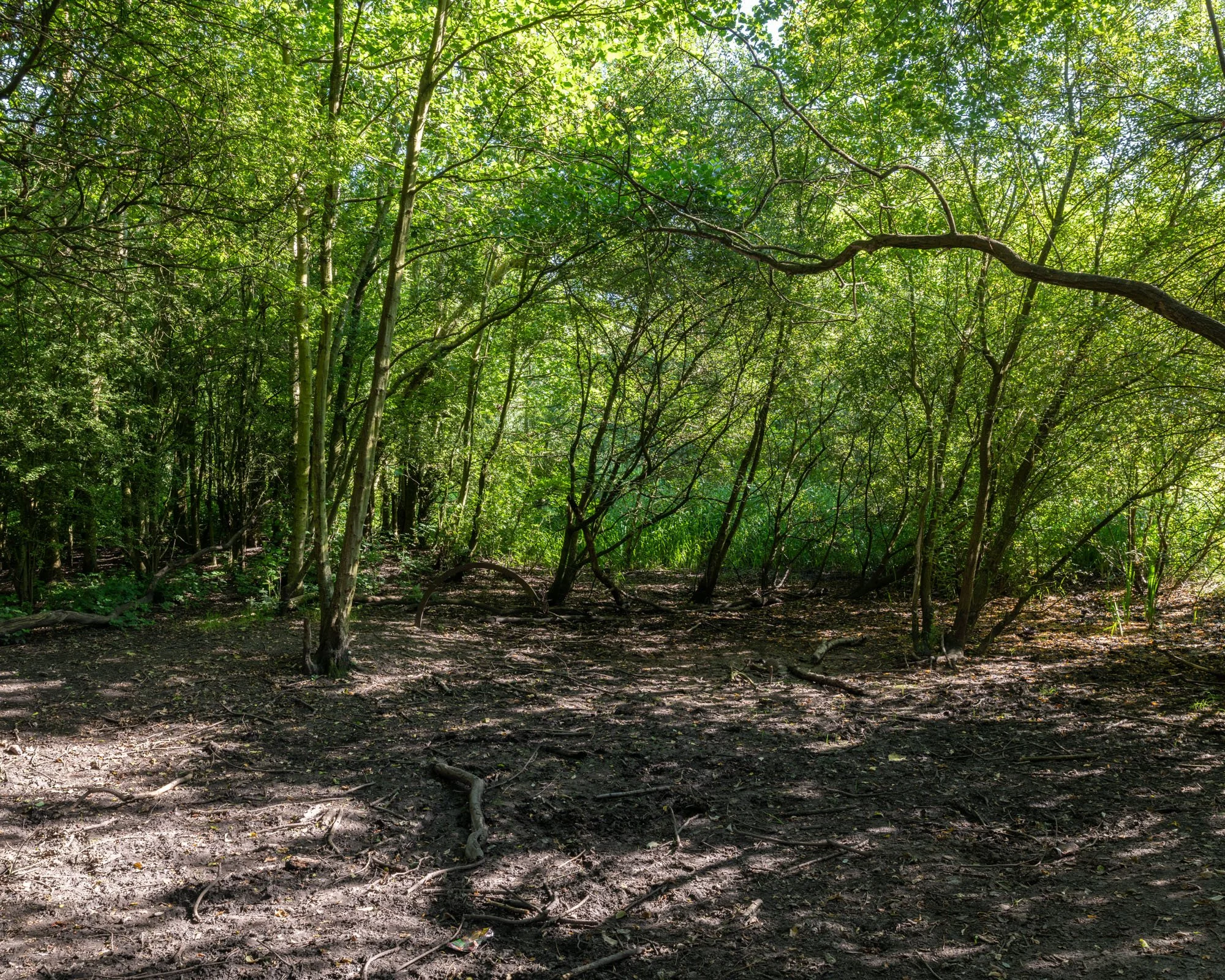
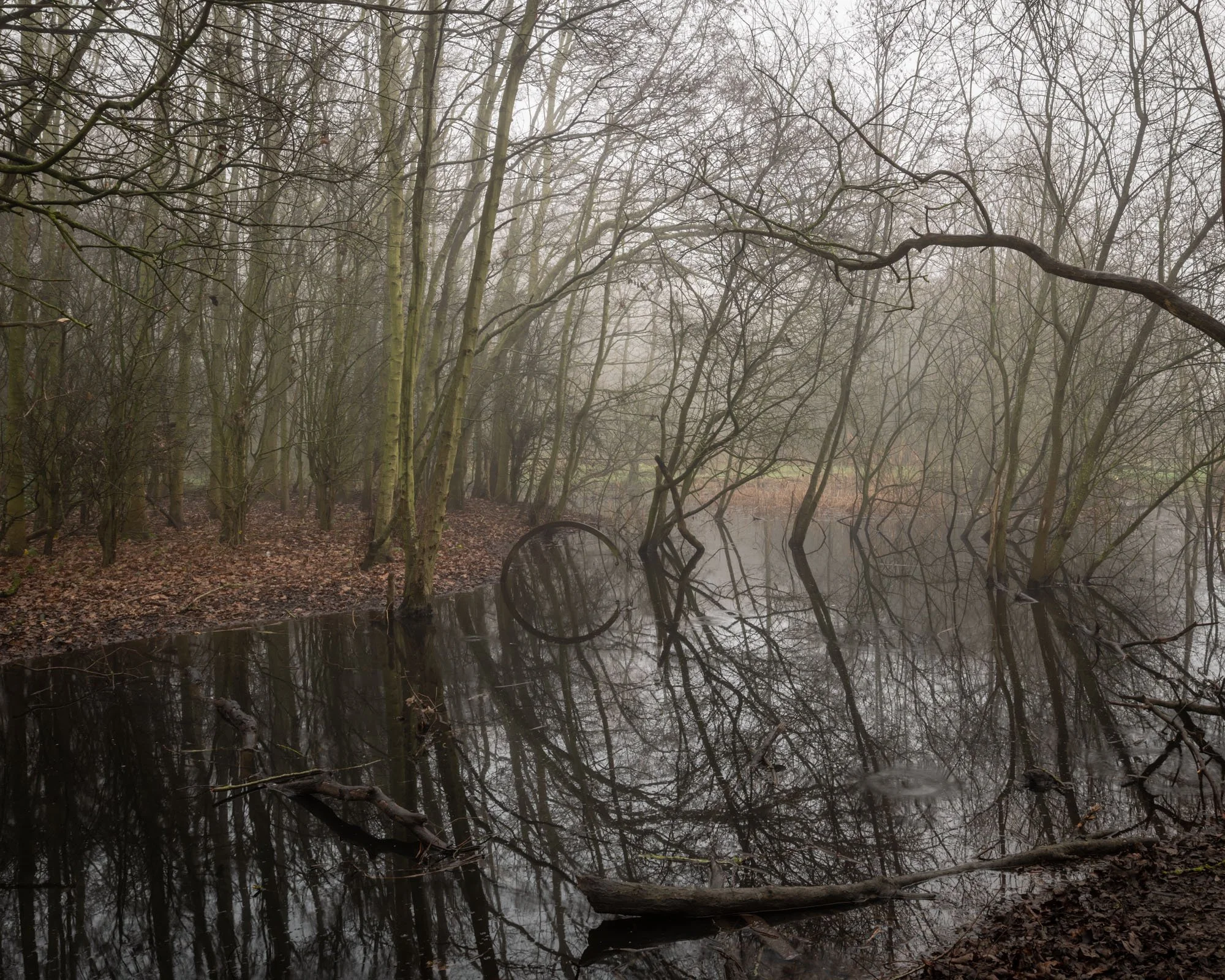
I also started photographing two areas with almost a fixed-point perspective. There was a pond that I photographed over several years, more or less from the same viewpoint. One key element in those photographs was a branch that came in from the right. When I went back just a few weeks ago, I saw that the tree had been cut down, and the branch was gone. Maybe that's an indication that it’s time to stop, that reference is gone. It showed me that perhaps it’s time to conclude this work and begin the long editing process.
Is it different from project to project in terms of the number of final images compared to the total you took? I mean, percentage-wise, could you say it's around 10%, 50%, or almost all of them?
I think it varies from project to project. Probably around 50% is a good estimate. For example, in the "River to River" project, there were about 250 photographs, and I narrowed it down to the best 50. That's kind of average. But in other projects, like "Personal Space," I felt I was on a bit of a hot streak. It seemed like almost every photograph I took was interesting or worthy of inclusion.
However, limitations like gallery space dictate that you have to reduce the number to something reasonable. Take "Skelmersdale" as another example. I’ve been reviewing those photos again recently, there were about 150 images, and I got that down to the best 75, so again, roughly 50%.
But you can't predict it. Things change over time. It's funny, photos I dismissed years ago, I now look at and think, "That's a good photograph. Why didn't I choose that one in the first place?" I don’t know why. Maybe it's because as you get older, you’ve seen more work, more bodies of work from other photographers. Your reactions evolve, even against things you did early on.
I feel like I’m starting to free up creatively. I used to need projects with clear boundaries or intellectual concepts to give me a framework. Now, I find myself going through work that doesn’t fit into specific project parameters, like a range of landscapes without a defined theme. Yet, they feel worthy and interesting. Curating and making sense of them without an original concept is intriguing. It’s not totally random, but it’s heading in that direction.
What is the key for you when it comes to refining a project? Do you approach it by cutting down photos or by adding more? Is it simply about whether you like a photo, or is there a specific idea or criteria that determines whether a photo should be included or removed from the project?
I think technical concerns are quite important. If there’s an issue like camera shake or any other technical flaw, that photo can be dismissed immediately. Although, as I mentioned earlier, scanning can sometimes help repair certain problems.
Repetition is another factor. If you've taken similar photographs on consecutive days, it doesn’t make sense to include all of them. You really have to choose the best one that aligns with the concept of the project and what you're trying to achieve.
It can be difficult because you have to be hypercritical of your own work. Since you took the photograph, you naturally think it’s worthy. But stepping back and getting other people’s opinions can be really helpful.
In the exhibition, there is a film about your mother, shown alongside photos of her houses. Why was it important to share the personal story with the pictures?
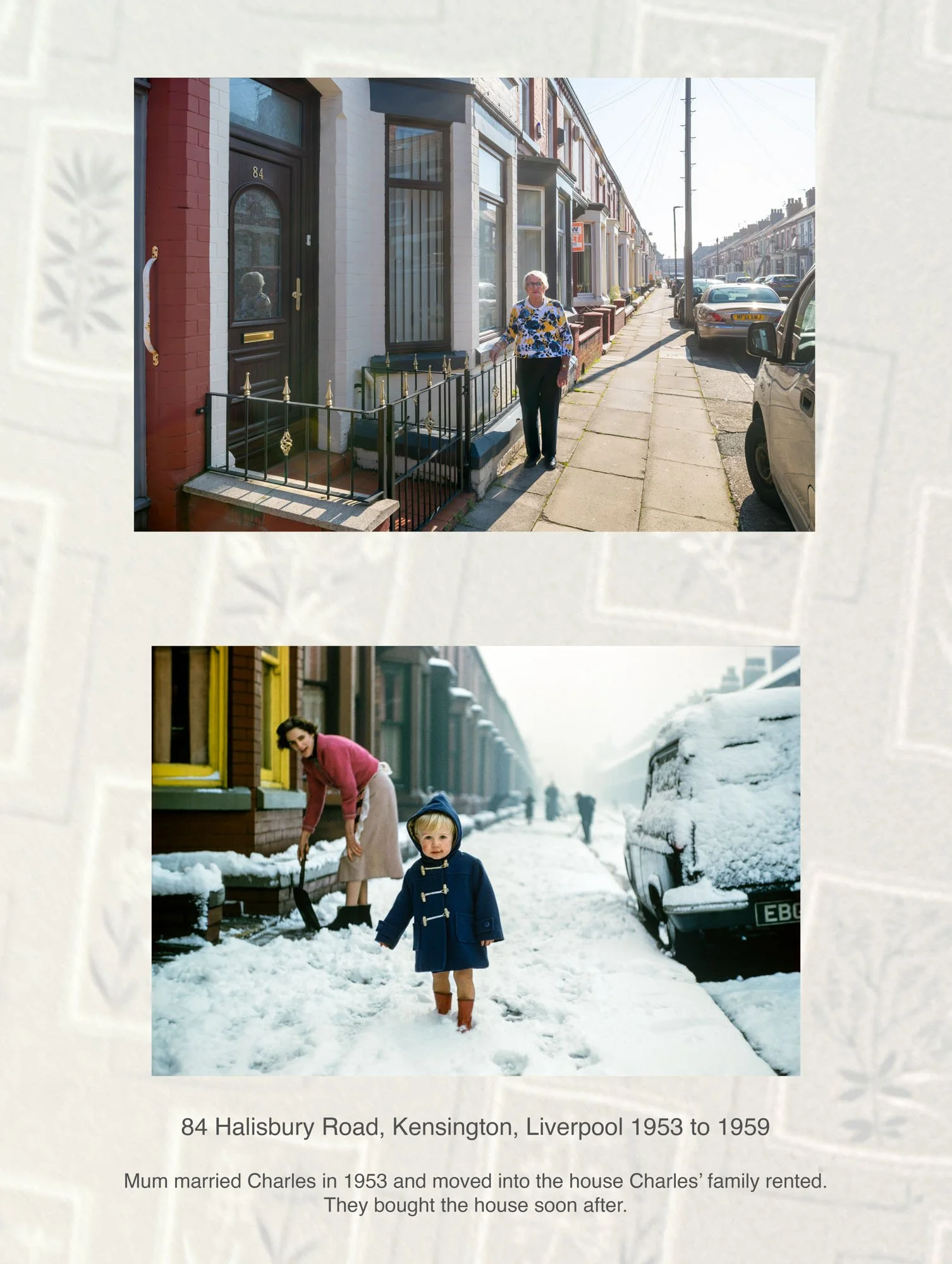
That’s really a kind of progression. A few years ago, I was going through old family photographs, scanning them, photos my dad had taken. There were quite a few from inside the houses they lived in. At the same time, my daughter was working on a personal family history project, which sparked my interest in turning this into something more focused on my mum.
I had the idea of photographing her outside every house she had lived in. Our family had moved from a terraced house in a working-class area of Liverpool to a detached house in Ainsdale. The idea of social progression was significant to me. I managed to photograph her outside these houses while she was still able.
Then she started to fall ill with Alzheimer’s disease. I began recording her naturally, just sitting in her bedroom, she’d start telling me stories about her youth. Some were really funny, others quite sad. I had these recordings of her voice, and I thought, what can I do with them? I felt it was important for people to hear her voice.
So, I combined them with the photographs of her outside our houses. It all tied into the themes of proximity and personal relationships, deeply connected to my own life story because I was part of it. I believed her voice should be preserved. It turned out really well, people grew quite emotional when viewing it in the gallery.
We couldn’t display all the photos of my mother outside the houses due to space limitations. Unfortunately, she passed away at the end of May. It was expected towards the end.
I’m sorry to hear that.
Thank you.
It added another layer of meaning to the project. I’m so glad I documented her story when I did. It feels like I’ve preserved a large part of her life story. It’ll be interesting to see how people react to it in different contexts. At the Open Eye Gallery in Liverpool, where both my mother and I were born and raised, people could relate to the housing in Liverpool and Ainsdale, Southport. I’m curious to see if it evokes the same reactions when it travels to Bristol, a different venue, a different city, although one with a cultural background similar to Liverpool.
One project that caught my eye was Personal Space 1980 - 1984.
This is a series of photographs taken of families engaged in day-to-day activities in the "safe" spaces of homes and gardens. Based on the snapshot aesthetic and the compositional mistakes that can occur with family photographs, they take a humorous look at many situations that happen as a natural part of family life. The work was exhibited at The Open Eye Gallery in Liverpool and published in Creative Camera, issue 6/1988.
Was it like you walked with the camera and saw it, or was it like you were walking around the scene regularly and then thought, "I'm just going to picture it," right?
For that particular project, I would have the camera with me quite often. So, if we were sitting around the front room, just watching television, or my sister was reading a book, or in the garden, people sunbathing and that type of thing, it just interested me, those little domestic activities. I photographed them in a very careful, structured way. They weren’t random, even though they might look random; they were very carefully composed with the camera.
I worked on that for a couple of years, off and on. It was interesting in the way I looked at a certain subject, in a way that wasn’t perhaps obvious.
What is the key to a good family photograph that's not just cliché, like everyone standing and smiling? Is it because people are aware when you walk around with the camera? Is it better to have the camera all the time so people get used to it, or is it more about being sneaky or surprising to catch those moments that feel unstaged?
I think they were just used to me. They thought I was an oddball anyway, so the fact that I was using the camera a lot, they just ignored it, ignored me and the camera and flash, really. They kind of wondered what I was doing, but in one sense, I explained the idea, and after that, they just ignored me.
There was no sneaking around or anything. They were fully aware of what I was doing. Again, it was that idea of collaboration. They were knowing collaborators within the project, I guess. They perhaps didn’t visualize exactly how the photograph would turn out, but they knew I was taking the photographs and what I was doing. It was meant to be humorous; it didn’t show any really awful things.
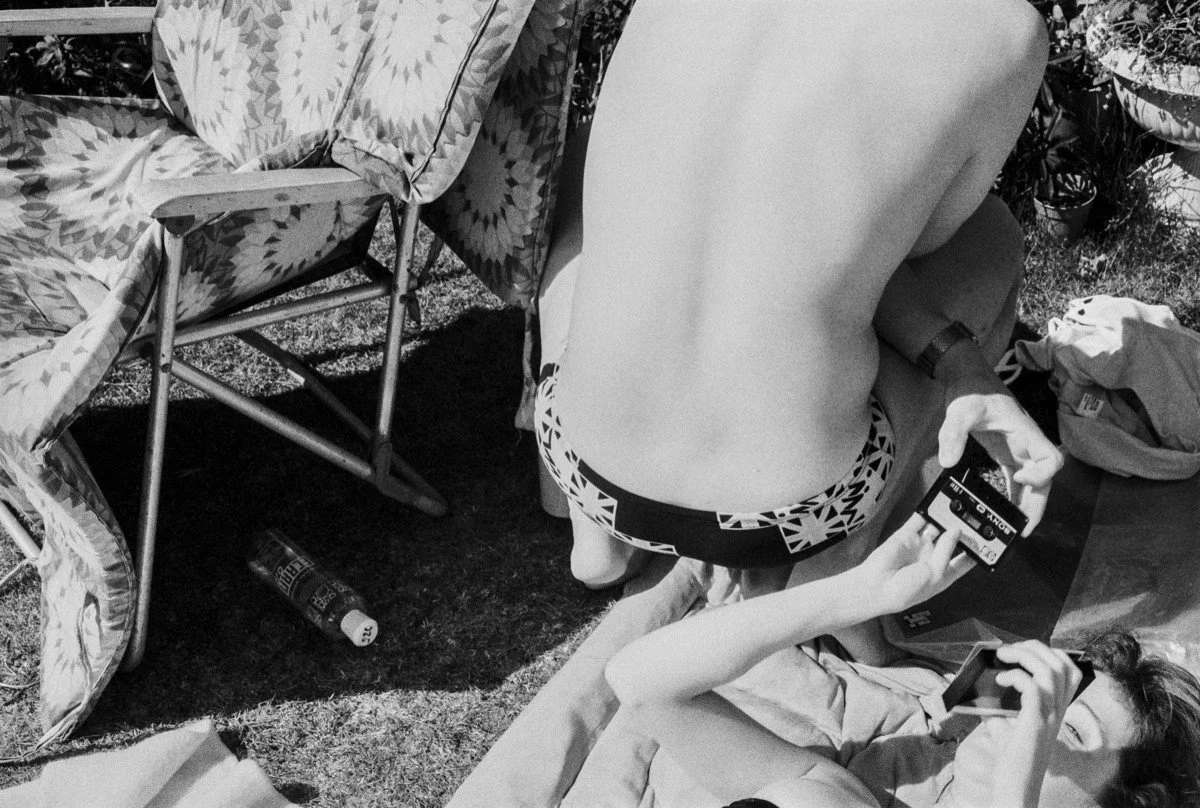
So was this like a play on, not bad family photos, but anti-cliché family photos? Was there an inspiration you took from somewhere that made you want to do this?
It definitely was a play originally on bad family photographs. The idea was that if you look at the photographs, certainly some of the early ones, you could say they were mistakes, things obscuring people’s faces. In some of the later ones, I moved away from the idea of making them anonymous. In those, they were more about the people rather than me trying to play around with composition and structure.
You can look through any family snapshot book or album and find quirky things, like, why have you photographed that? Or there’ll be a photograph with the Eiffel Tower sticking out of somebody’s head, little miscompositions like that. I was playing around with that idea as well.
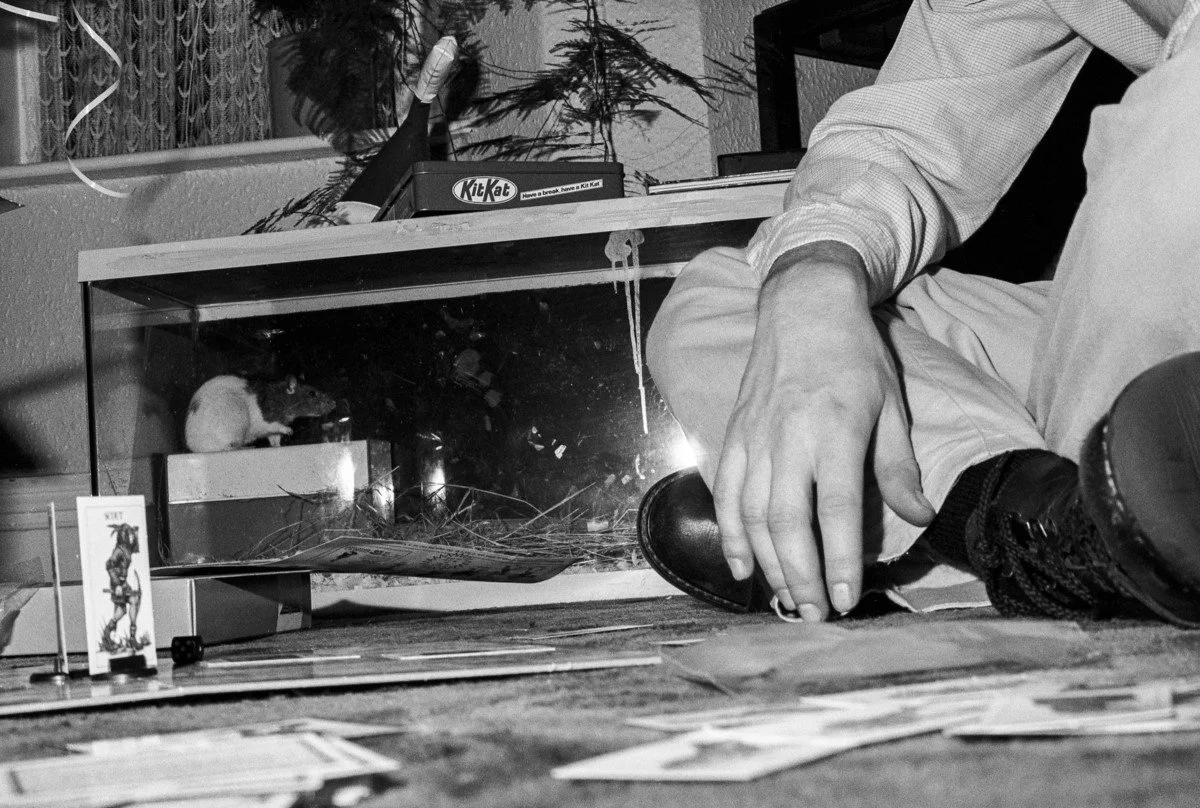
I really like the idea because I think it would make so many family archives much more enjoyable. Just having something unusual to look at, allowing you to feel the moment rather than just focusing on the people. It captures the moment, the movement, the angle, and all those details.
Yeah, and again, you couldn't repeat them. It was a one-shot thing, and if it worked, it worked. I couldn’t pose anybody or ask them to sit somewhere specific. It all just happened naturally, like fly-on-the-wall stuff. Everything unfolded in front of the camera in real time. It either worked or it didn’t.
Did you ever think, "This photo looks too normal, I should have tilted the screen or the viewfinder"? Did thoughts like that cross your mind?
No, to be honest. That would imply too much pre-organization. It was very much a reactive project. The only progression was that I became more interested in actually showing people, showing their faces, like my own children, for instance. It became more like a family album with pictures of people and their expressions. But I was still thinking about ways in which things can happen, capturing elements of humor, for example, like the kids in the bath covered in soap bubbles so you can’t even see their faces. That type of thing.
Occasionally, I’ll still take a photo if something strikes me as funny because humor was an important part of that project. They’re meant to be humorous.
So, it had to make you smile when you looked at the photo. That was the key point when deciding to include it in the project?
Yes, definitely. They’re meant to be funny.
So, when someone wanted a proper family portrait, you weren’t the one they’d ask? Like, "We’re just going to get a picture of our legs"?
No, not at all. I avoided that at all costs, and they avoided asking me.
Taking photos wasn’t like, "We have a photographer in the family, so Steven should do it"?
Exactly. I always deliberately made things go wrong so they wouldn’t ask me again.
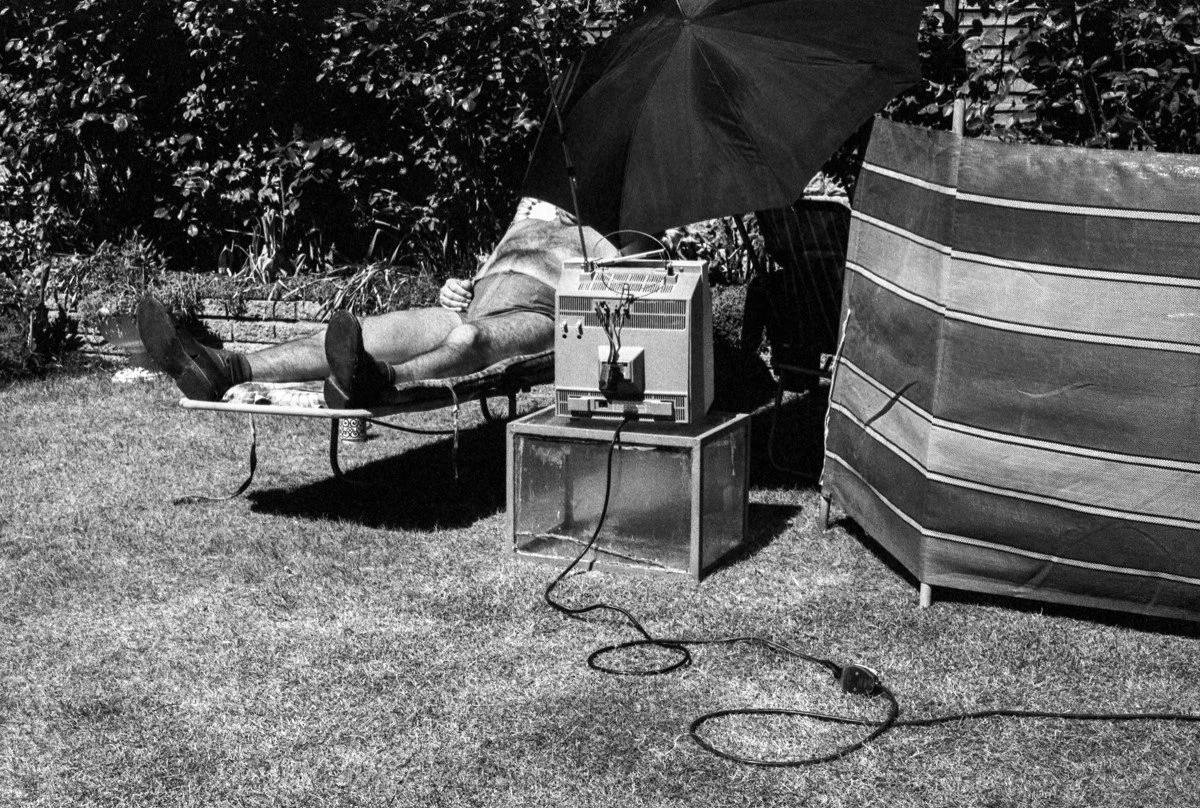
I really enjoyed this type of project because it's different from what you usually see.
I'm glad you said that. I don't deliberately try to be different, but everyone has a unique perspective on things. I do tend to view things differently because imagination is quite important in my work. Imagining how things could be, how they could improve or differ, and imagining ways to be more creative.
Also, being responsive is essential because I have a solid understanding of photography traditions and how photographs have been made, as well as the works of other photographers. Acknowledging sources and reacting to previous work is, I think, quite significant.
Yes, I agree with that.
The main idea behind the Proximity exhibition. It’s all about that connection to people and place. As I mentioned earlier, we have photographs from all over the UK, commercial works, and projects like the triangulation project we're currently working on. But it's that connection that holds the most importance for me.
Are you looking forward to the exhibition?
Yeah, I am. A lot. The work was previously on display at the Open Eye Gallery, and I happened to bump into Martin Parr. I kind of just know him, you know. I invited him and told him about the exhibition. I said, "I'll pop along to see it when I go to Liverpool." Honestly, I didn’t really expect him to, but he did.
Are you involved a lot?
He sent me an email with some very complimentary comments. I replied, "Well, if you're that interested and you like the work that much, how about putting it on at the Martin Parr Foundation?" He said, "Yeah, that’d be great." So we went down there and showed the work that was in the Open Eye Gallery. Obviously, because it’s a smaller space, we had to cut some of the work out. There won’t be any portraits in it, but there will be examples of all the other work. I’ve worked with the curator there to sort out certain layouts of the work.
Martin: Thank you so much for joining me today. I hope everything goes well with the exhibition. It was a pleasure speaking with you. Thank you again.
Stephen Mccoy: Thank you for having me. Have a great day!
More photography books and interviews?
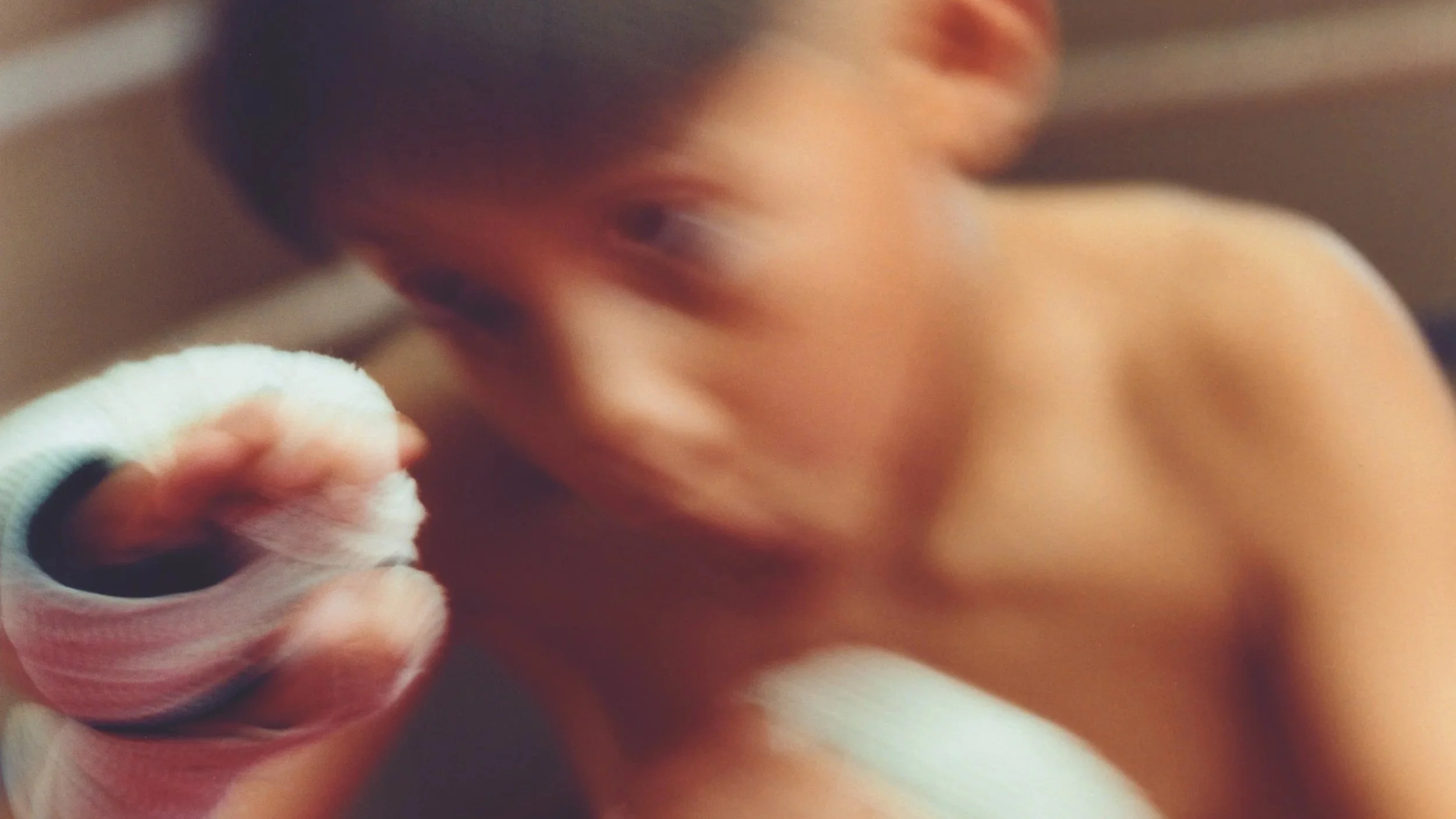
We'd love to read your comments below, sharing your thoughts and insights on the artist's work. Looking forward to welcoming you back for our next [book spotlight]. See you then!
Robin de Puy could no longer make this project alone. She first photographed Randy in Ely, Nevada, during a 2015 road trip and kept returning to him for more than ten years. Interviews