AT A GLANCE
- Known for
- Environmental portraits of artists, composers, writers and politicians, such as Igor Stravinsky at the piano
- Worked in
- Mostly black and white, and also color
- Camera
- A large-format camera on a tripod
- Also
- Abstract still lifes and collages; taught photography at Cooper Union for many years
- Start with
- Arnold Newman (Taschen, 2006)
- Links
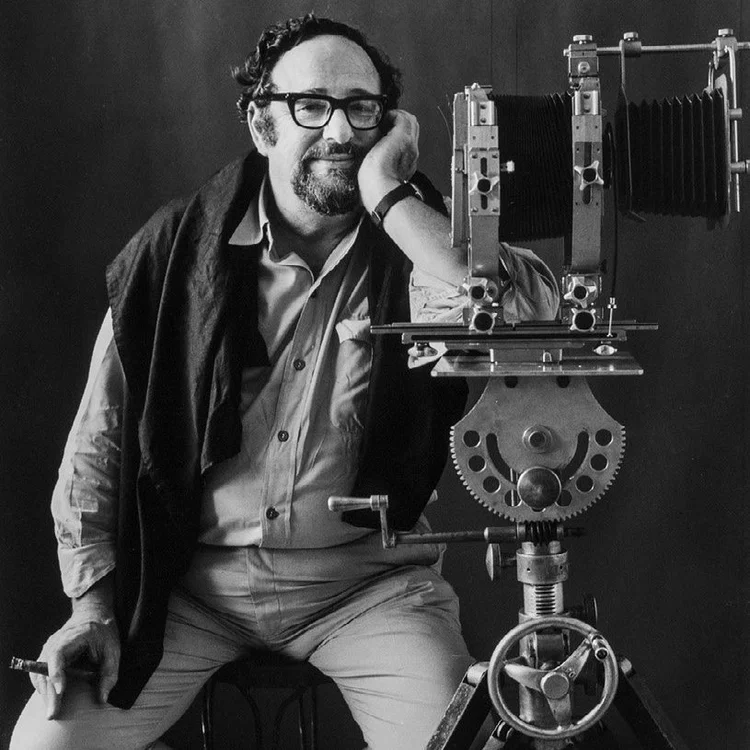
Arnold Newman (1918–2006) was an American portrait photographer. He is known as the pioneer of the environmental portrait: he showed people in places that tell something about their life and work. In a career of sixty years he photographed artists, writers, composers, scientists and presidents.
The story
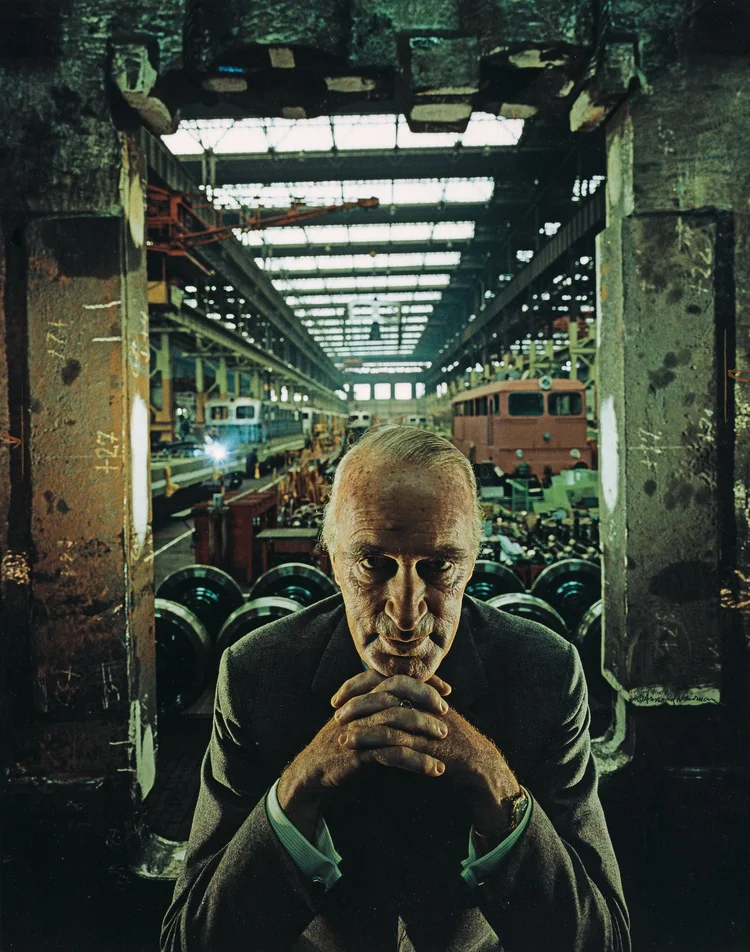
In 1963, Newsweek asked Arnold Newman to photograph the German industrialist Alfried Krupp. Krupp had been convicted as a war criminal and later pardoned. Newman was Jewish, and to him Krupp was the devil. At first he turned the job down.
In the end he went. Krupp sat on a platform, with his factory behind him. Newman asked him to lean forward. Krupp clasped his hands together under his chin. “My hair stood on end,” Newman said later. The color portrait became one of the most important pictures of his life.
He had been learning to use a setting for a long time. Born in New York in 1918, he grew up in Atlantic City and Miami Beach, where his parents owned hotels. He studied art at the University of Miami, but after two years there was no money to go on. In 1938 he started work in a portrait studio in Philadelphia, making 49-cent portraits. In his free time he made abstract and documentary pictures.
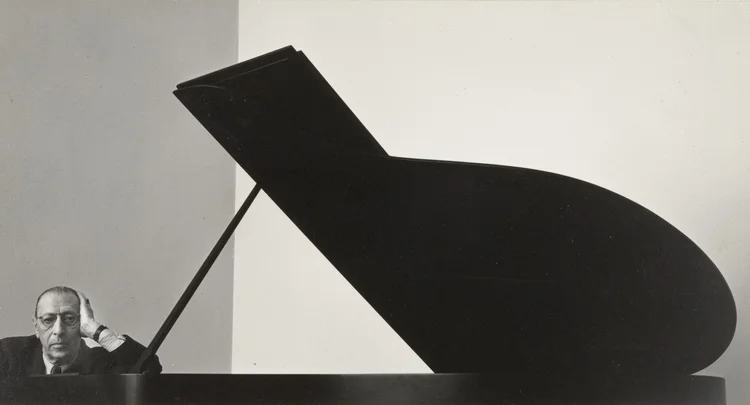
In 1941, Beaumont Newhall of the Museum of Modern Art and Alfred Stieglitz saw his work. They gave him a show at the A.D. Gallery. In 1946 he moved to New York and opened his own studio. That year Harper’s Bazaar sent him to photograph the composer Igor Stravinsky. Newman placed him in a corner, below the huge black lid of a grand piano. The magazine rejected the picture. Today it is his signature image.
Before Newman, his former assistant Gregory Heisler once wrote, a portrait was “generally a box with somebody in the center.” Newman used what was around the person: a piano for a composer, a factory for an arms maker. For sixty years he photographed artists, writers, scientists and presidents this way. He did not like being called the father of the environmental portrait, but the name stayed.
With Krupp, the factory did more than show a man at work. It also showed what the photographer felt. Newman admitted that his own feelings shaped that picture. For him, a setting was never just a background. “The surroundings had to add to the composition and the understanding of the person.”
The work


- 1918Born on March 3 in New York City
- 1936Begins studying art at the University of Miami
- 1938Starts work in portrait studios in Philadelphia
- 1941Beaumont Newhall and Alfred Stieglitz give him a show at the A.D. Gallery
- 1945Solo show Artists Look Like This at the Philadelphia Museum of Art
- 1946Moves to New York, opens his studio and photographs Igor Stravinsky
- 1963Photographs Alfried Krupp for Newsweek
- 1999Retrospective at the International Center of Photography and its Infinity Award
- 2006Dies on June 6 in New York
Lessons
Make the setting speak. Stravinsky sits next to the black shape of his piano. The room is part of the portrait, not just a background.
Interest comes first. Newman believed a portrait must excite the viewer even if nobody knows who the sitter is.
Keep your own work going. While he made cheap studio portraits for a living, he made abstract and documentary pictures in his free time.
Try this: photograph a friend in the place where they work or practice a hobby. Choose one object that says who they are. Build the whole frame around the shape of that object.
Gear
Few details about his equipment could be verified. The sources agree on the format.
Large-format camera: he used a large-format camera on a tripod and worked to record every detail of a scene.
Books
Arnold Newman (Taschen, 2006). A large survey of 280 pages, edited by the curator Philip Brookman. Taschen first published its Newman book in 2000, in English, German and French. It is the easiest way to see his best-known portraits of artists, musicians and politicians in one place, so it is a good first book.
Arnold Newman: One Hundred (Radius Books and Howard Greenberg Gallery, 2018). Made for the hundredth anniversary of his birth, together with an exhibition at Howard Greenberg Gallery in New York. It shows rarely seen pictures, like Isamu Noguchi posed behind his sculptures and Marcel Duchamp with a cigarette, standing in a web of violin strings. The text is by Gregory Heisler, his former assistant: “Arnold Newman conceived a new vocabulary for photographic portraiture.” For readers who already know the famous portraits and want to see more.
One Mind’s Eye: The Portraits and Other Photographs of Arnold Newman (New York Graphic Society, 1974). An early career book, with a foreword by Beaumont Newhall, the museum curator who helped discover Newman in 1941, and an introduction by Robert Sobieszek. As the title says, it shows his portraits and also his other photographs. A book for collectors who want to see how his work looked in print during his lifetime.
Arnold Newman: At Work (University of Texas Press, 2013). A 296-page book in the Harry Ransom Center Photography Series, by Roy Flukinger, with an introduction by Marianne Fulton. It looks at how Newman made his pictures, including the Stravinsky and Krupp portraits. For photographers who are curious about method as much as results.



Explore the intriguing story of Arnold Newman's portrait of Alfred Krupp, a convicted Nazi war criminal, and how the Jewish photographer used his art to exact a subtle, personal revenge on a man who had caused immense suffering during World War II.